Sustainable Development Goals
Current Project Status:
COMPLETED | Acquisition Evaluation | Technical & Commercial Due Diligence
Organizations Involved:
Klean Industries, Klean Capital, Panama Marine Waste & Oil Recovery Operators, Major Oil Refiners
Services:
Design & Engineering, Component Supply, Feasibility Study, Due Diligence, Supply Chain Management,
Marine Slop Oil Recycling & Waste Oil Re-refining in Panama
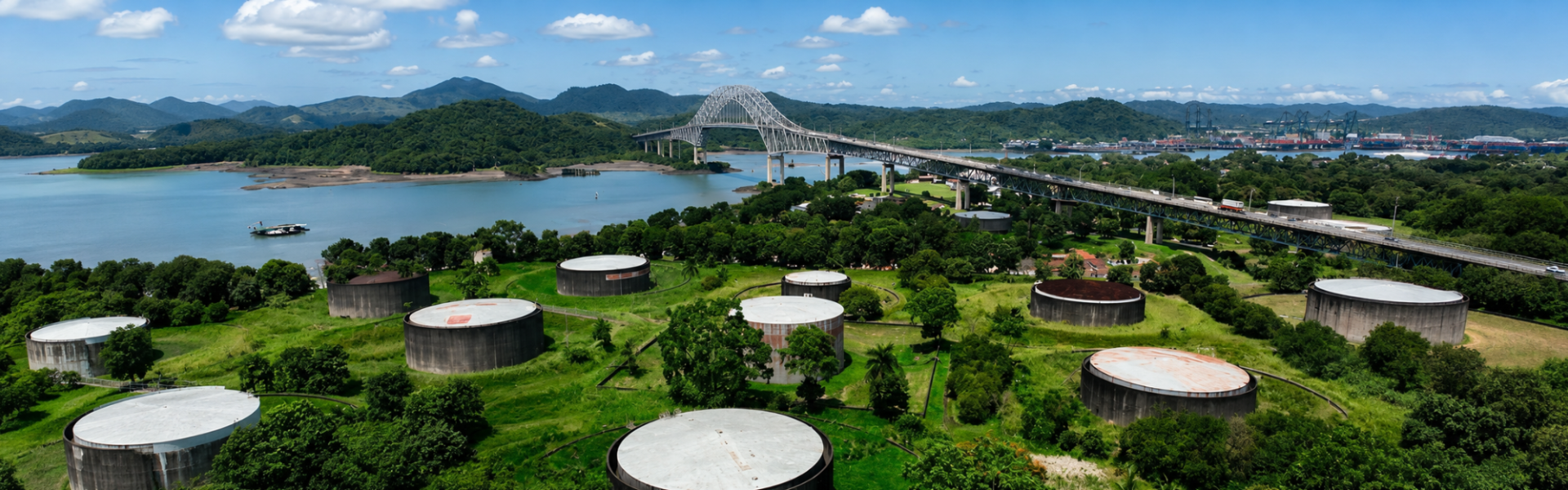
Klean Industries and Klean Capital evaluated the potential acquisition and modernization of an established marine slop-oil collection and waste-oil re-refining operation serving vessels around the Panama Canal. Located at La Boca in Balboa, adjacent to the Pacific entrance of the Canal and beneath the Bridge of the Americas, the project combined marine waste collection, hydrocarbon recovery, storage infrastructure and an operating micro-refinery.
The opportunity demonstrated how ship-generated oily wastes can be transformed from a disposal liability into valuable recovered hydrocarbon products while providing vessels with an essential environmental service.
The Challenge
The Panama Canal is one of the world's most important maritime transportation corridors, with more than 13,000 vessels transiting the Canal during fiscal 2025. Those vessels generate oily residues including sludge, oily water, contaminated fuels, lubricants and tank-cleaning wastes that must be properly collected and managed.
International MARPOL regulations strictly control the discharge of oil and oily mixtures from ships, creating an ongoing requirement for compliant marine waste collection, reception and treatment services. Panama has developed an established environmental-services industry around this requirement, including operators authorized to collect, transport, treat and manage MARPOL Annex I oily wastes.
For Klean, however, the opportunity extended well beyond waste disposal. Marine slops can contain significant quantities of recoverable hydrocarbons. Once water, solids and contaminants are removed, suitable hydrocarbon fractions can be processed and upgraded into commercially useful petroleum products. This creates an attractive circular business model. Vessels require a compliant service to remove and responsibly manage their oily wastes, while the collected material can become feedstock for a downstream oil recovery and re-refining operation.
Instead of viewing marine slop solely as a waste requiring disposal, Klean evaluated whether the existing Panama operation could be transformed into an integrated waste collection, resource recovery and circular-oil re-refining platform. Klean visited and evaluated the facility on multiple occasions while considering the potential acquisition of the operating businesses and processing assets. Its strategic location, proximity to Panama Canal shipping, access to marine feedstock and existing petroleum infrastructure made the opportunity compelling.
However, a strategically located operating facility is not automatically a bankable acquisition. Klean needed to establish whether the physical assets, marine feedstock position, operating rights, processing performance and represented commercial value could be independently verified to the standard required for investment.
The Solution
Klean Industries and Klean Capital approached the opportunity as both an industrial project and a capital investment. Klean Industries evaluated the physical facility, processing equipment, feedstock pathway, storage infrastructure, oil recovery process and modernization potential, while Klean Capital assessed the acquisition economics, operating rights, commercial performance and risks associated with deploying capital into the existing businesses. This combined approach reflected a core Klean principle:
An operating facility is not automatically an investable project.
The technical evaluation considered how collected marine slop oils could be received, characterized, segregated and processed through improved separation, dewatering, filtration, refining and product-quality systems. The objective was not simply to acquire an existing micro-refinery. Klean evaluated how the operation could potentially be modernized into a safer, more efficient and commercially robust circular hydrocarbon recovery platform capable of producing consistent recovered petroleum products. The physical plant, however, represented only one part of the opportunity.
The greater strategic value potentially existed upstream in the ability to secure and collect marine feedstock and downstream in the ability to convert that feedstock into commercially valuable products. For this reason, Klean's due-diligence process focused on connecting physical production with financial performance.
Incoming marine slop volumes should reconcile with material entering storage. Storage movements should reconcile with refinery throughput. Refinery throughput should reconcile with recovered-product yields and inventory. Product inventory should ultimately reconcile with customer sales, invoices and cash receipts.
In a physical resource-recovery business, mass balance and financial performance should tell the same story.
The evaluation also examined the regulatory and operating rights supporting the business. The processing operation was located within the Panama Oil Terminals area under an underlying concession arrangement, making site access, operating authorizations, marine waste permissions and the continuation of those rights following a potential acquisition essential components of the transaction.
Ultimately, sufficient documentation was not made available to independently substantiate several material aspects of the proposed acquisition to the standard required by Klean Industries and Klean Capital. Without adequate verification of the underlying business fundamentals, Klean elected not to commit acquisition capital.
The Outcome
The Panama evaluation demonstrated why disciplined technical and commercial due diligence is essential when acquiring existing recycling, refining and waste-to-value infrastructure. Klean identified a genuine underlying market opportunity. Panama combines major international vessel traffic, a continuing requirement for marine waste-management services, existing petroleum infrastructure and strategic access to both the Atlantic and Pacific oceans.
Properly developed, marine slop-oil recycling and waste-oil re-refining can transform regulated oily wastes into valuable circular hydrocarbon products while supporting cleaner and more responsible maritime operations. Events following Klean's evaluation further reinforced the importance of this disciplined approach.
In April 2026, a major fire involving tanker trucks occurred within the La Boca operating area beneath the Bridge of the Americas, resulting in a fatality, injuries and subsequent government investigations. Regulatory action involving the underlying Panama Oil Terminals concession followed, bringing additional scrutiny to the site's operating and concession arrangements.
These developments did not eliminate the underlying opportunity for marine oil recovery in Panama. Instead, they demonstrated why process technology, operational safety, environmental compliance, secure regulatory rights and independently verified commercial performance must operate together. For Klean Industries and Klean Capital, the Panama project became an important example of responsible circular-economy project development.
Equipment alone does not create a viable technology platform. A refinery without secure and compliant feedstock does not create a sustainable business. And commercial performance that cannot be independently substantiated cannot provide the foundation for responsible investment.
The Panama experience continues to inform Klean's approach to brownfield acquisitions and resource-recovery projects worldwide, identifying where existing infrastructure can be modernized, valuable resources can be recovered and investment capital can be deployed responsibly to create long-term value.
Learn More:
Are you looking to acquire, modernize, finance or develop a waste-oil, marine slop-oil or pyrolysis-oil processing facility?
Klean Industries combines technology evaluation, engineering, feasibility studies, process integration and project development with the investment and commercial capabilities of Klean Capital to help clients identify viable projects, reduce acquisition risk and transform waste-derived hydrocarbons into commercially valuable fuels, refinery feedstocks and circular resources.
From preliminary project evaluation and due diligence through technology selection, feasibility, financing, engineering and deployment, the KleanTeam provides an integrated pathway from opportunity to commercially viable project.
