
Sustainable Development Goals

PROJECT INFORMATION AT A GLANCE:
Project Status:
Successful refinery co-processing demonstration; integrated tyre-recovery facility in development
Organizations Involved:
Klean Industries, Viva Energy, CEVA Logistics, CMA CGM, KBR, InvestVictoria, Sustainability Victoria, Tyre Stewardship Australia, Several Tyre Recycling Companies
Services / Equipment:
Design & Engineering, Component Supply, Feasibility Studies, Due Diligence, Supply Chain Management, Operator Training
Viva Energy successfully co-processed 10 tonnes of tyre pyrolysis oil produced using our technology alongside conventional crude at Geelong Refinery. The demonstration connected our operating technology with a major refinery and its fuel-production infrastructure, giving the Australian tyre-recovery development a tested downstream pathway.
Our contribution brings together the technology that produces the oil, the development of an Australian supply source and the industrial relationships needed to turn recovered hydrocarbons into marketable products. For investors, the significance is practical: an established refiner has processed the material that the proposed recycling facility is designed to supply.
The Challenge
Connect recovered tyre oil with a substantial industrial market
A tyre-recycling project needs a destination for each recovered product. Carbon must meet the requirements of manufacturers, steel needs a recycling outlet, and oil must satisfy the receiving processor’s requirements. The oil route influences product preparation, logistics, investment and the commercial agreements supporting the plant.
For our Australian development, the opportunity was to connect tyre pyrolysis with Viva Energy’s Geelong Refinery. Co-processing introduces a suitable recovered oil alongside conventional refinery feedstocks, allowing existing infrastructure to contribute to circular-fuel production.
That required a practical demonstration with material produced using our technology. The refinery relationship also had to fit a much larger supply chain: tyre collection, resource recovery, product upgrading and delivery into industrial markets.
The Solution
Demonstrate the oil in an operating refinery
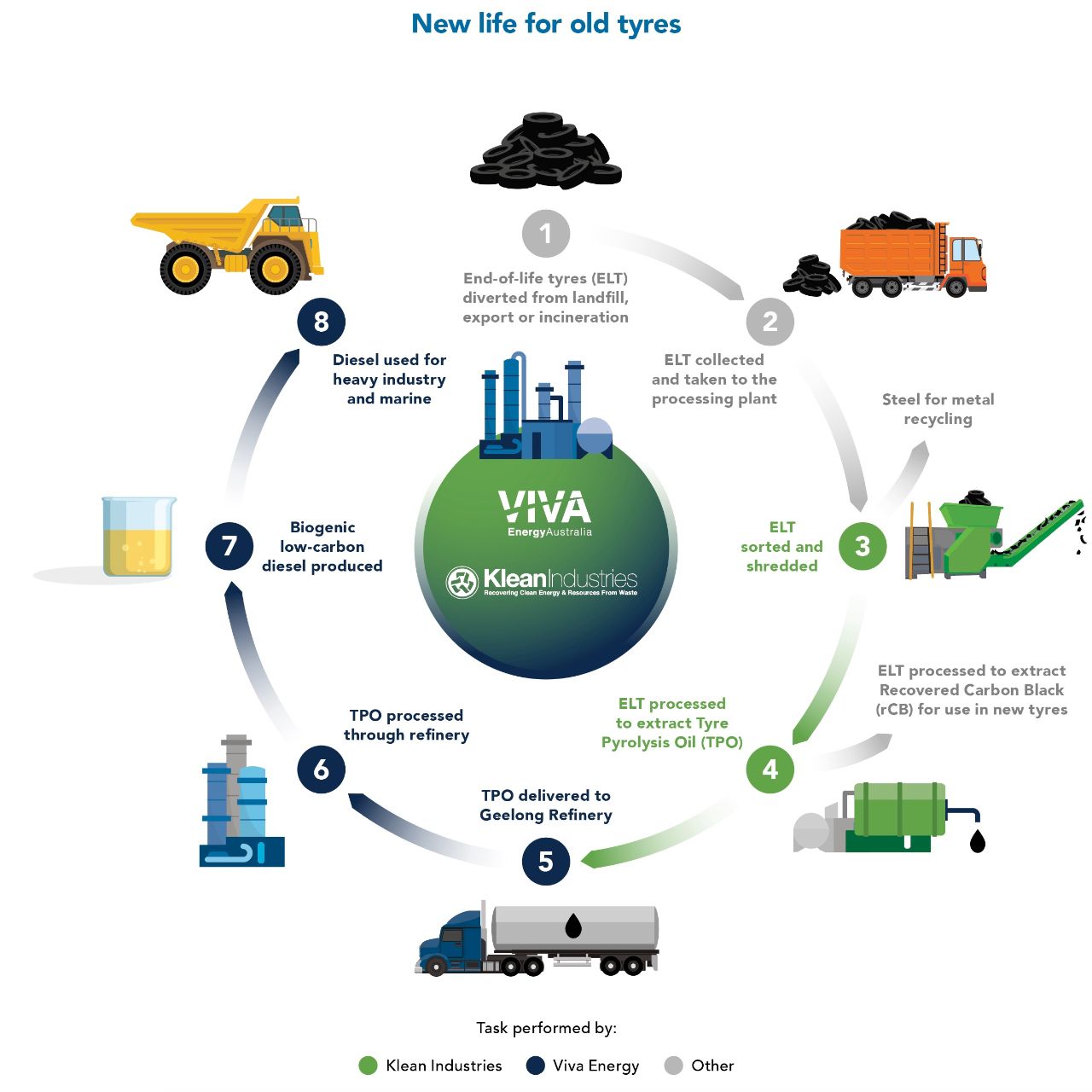
Klean and Viva Energy established a collaboration to assess a Melbourne tyre-recycling facility capable of processing up to 80,000 tonnes of end-of-life tyres annually. The proposed arrangement connects recovered carbon black and steel with material markets and directs the recovered oil toward Geelong for further processing.
The collaboration advanced to a refinery demonstration using 10 tonnes of tyre pyrolysis oil imported from the operating reference in Poland. Viva successfully processed the oil alongside crude to produce a range of refinery fuels and products.
This result gives the development a concrete technical reference for the refinery route. The selected oil was processed in an existing industrial facility; commercial supply is developed around the refinery’s acceptance requirements, product qualification and agreed volumes.
Read the successful Geelong co-processing announcement >> GO.
Develop the marine and industrial fuel opportunity
Viva Energy supplies marine and industrial fuel markets as part of its wider refining and distribution business. This gives our oil a route into established fuel manufacturing and customer channels. Geelong provides the processing connection; the finished product and its destination depend on the selected refinery route and customer specification.
CEVA Logistics connects tyre distribution and reverse collection, while its parent company, CMA CGM, represents a potential marine-fuel customer. Ships serving the tyre supply chain could ultimately use fuel incorporating resources recovered from those tyres. This is a commercial opportunity to connect the collection system with downstream fuel demand.
“By transforming end-of-life tyres into valuable resources, we are not only reducing waste but also pioneering new paths for low-carbon fuel production.”
— Lachlan Pfeiffer, Chief Strategy Officer, Viva Energy
Match the product route with the oil’s properties
The project basis identifies 35–40% biogenic content in recovered tyre oil, associated principally with natural rubber in the feedstock. This describes the oil’s biological carbon contribution; the lifecycle benefit of the finished fuel also depends on processing, logistics and the fossil feedstock displaced.
Our published upgrading concept identifies a product split of approximately 90% hydrocarbon product targeting very-low-sulphur fuel oil (VLSFO) quality and 10% naphtha-like product. These are development figures for an upgrading option. They are separate from the demonstrated Geelong co-processing result, which produced a range of refinery products.
The Outcome
A refinery demonstration supporting a larger recovery business
The successful 10-tonne trial established the central achievement of this case: oil produced using our technology was accepted and processed alongside crude at Geelong. It connects the proposed Australian supply source with a demonstrated downstream application.
On the published 60,000–80,000-tonne annual tyre-processing basis, our Australian project case identifies the following approximate annual quantities:
These are project-development quantities, distinct from the refinery trial. They describe the scale being developed, with product yields and saleable specifications established through the final process configuration and customer requirements.
The wider project case estimates more than 100,000 tonnes of annual CO₂ emission offsets and potential for hundreds of jobs. The carbon figure is a project estimate whose realization depends on the lifecycle basis and operating configuration.
Connect technology delivery with traceable product performance
We lead the integrated development and technology configuration. KBR’s EPCm role connects that work with engineering, procurement and construction management for the proposed facility. The TyreNova alliance provides the broader licensing and delivery framework for our tyre-pyrolysis technology.
KleanLoop is intended to connect feedstock movements, production data and recovered-product deliveries. Those records support traceability and the evidence needed for carbon-intensity assessment. Combined with the refinery relationship, this gives customers and investors a way to examine both where the material goes and the performance behind its environmental claims.
The commercial value comes from developing those connections together. The recycling facility supplies a product with a defined processing route, and the refiner gains access to a recovered feedstock backed by technology experience and a developing supply chain.
1. The refinery pathway has a demonstrated result. Viva successfully co-processed 10 tonnes of Klean-derived tyre oil at Geelong, providing a concrete downstream reference for project development.
2. The opportunity connects substantial supply with established fuel markets. The proposed Australian facility targets 60,000–80,000 tonnes of annual tyre processing, with Viva providing the refinery connection and marine fuel forming a potential end market.
3. We bring the industrial relationships into the project design. Technology, logistics, KBR’s delivery role and KleanLoop traceability support an integrated recovery business.
These are selected achievements and lessons. Further technical and commercial insights are available through an engagement with Klean.
WHAT DO THESE LESSONS MEAN FOR YOUR PROJECT?
Engage we to connect your recovered oil with the processing route, customer requirements and supply arrangements that give it commercial value. Geelong demonstrates why downstream market development belongs alongside the design of the recycling plant.
For new equipment developments, the paid Detailed Equipment Quotation (DEQ) establishes the preliminary process configuration and technical and commercial basis. A Detailed Feasibility Study (DFS) develops the project’s viability and supporting arrangements, followed by Front-End Engineering Design (FEED). Refinery qualification, oil-upgrading studies and strategic partnerships can be scoped to the specific assignment. Confidential technical and commercial information is shared within the agreed engagement and appropriate confidentiality arrangements.
Develop Your Circular Oil Recovery Project with Klean >> GO.
Https://vimeo.com/1070737045
ABOUT THE INFORMATION PRESENTED
This case describes a completed refinery demonstration and its role in our Australian development. Plant capacities, product quantities and environmental benefits are presented on their stated project basis. Further operating data, oil specifications and commercial arrangements are addressed through a defined engagement and appropriate confidentiality permissions.
This project addresses the United Nations Sustainable Development Goals (SDGs) by considering the goals and associated targets illustrated by the WBCSD’s Tire Industry Project (TIP). TIP provides a framework for action that outlines impactful pathways for the tire sector to contribute to achieving the Sustainable Development Goals (SDGs). To learn more about how our approach, solutions, and technologies contribute to advancing the SDGs, please review the report “Sustainability Driven: Accelerating Impact with the Tire Sector SDG Roadmap”.
