
Sustainable Development Goals





Project Status:
OPERATING 1985
Organizations Involved:
City of Vancouver, GVRD, BC Ministry of Environment, City of Burnaby, Fraser Health Authority, Babcock Wilcox, Alstom, BC Hydro, NORPAC, Veolia ES, Covanta,
Services / Equipment:
Consulting, Feasibility Studies, Due Diligence, CSR Education Plan
Burnaby’s waste-to-energy facility has converted residual waste into productive energy for decades, shifting from industrial steam supply to increased electricity generation as customer needs changed. Our case study examines how energy customers, equipment upgrades, and material recovery shape a facility’s lasting value, and how those lessons inform the development of your own waste-to-energy project.
The Metro Vancouver Waste-to-Energy Facility originally supplied steam to NORPAC. Over time, the facility expanded its operations to include electricity generation, creating a new market for its energy. When the mill closed, the facility redirected the steam to boost power production. Furthermore, enhanced metal recovery processes improved the value of the materials remaining after combustion.
For municipalities and investors, this is a practical infrastructure lesson: the value of a waste-to-energy facility develops through its operating life, its customer connections and the decisions made to keep it useful.
Vancouver is Canada’s third-largest metropolitan region, with roughly 2.5 million residents, the third-largest port in North America and about $25 billion in capital assets. The Greater Vancouver Regional District and its residents and businesses generated about 1,247,500 tonnes of garbage in 2021–2022, while the region’s recycling rate climbed from about 40 percent in 1995 to over 60 percent in 2018.
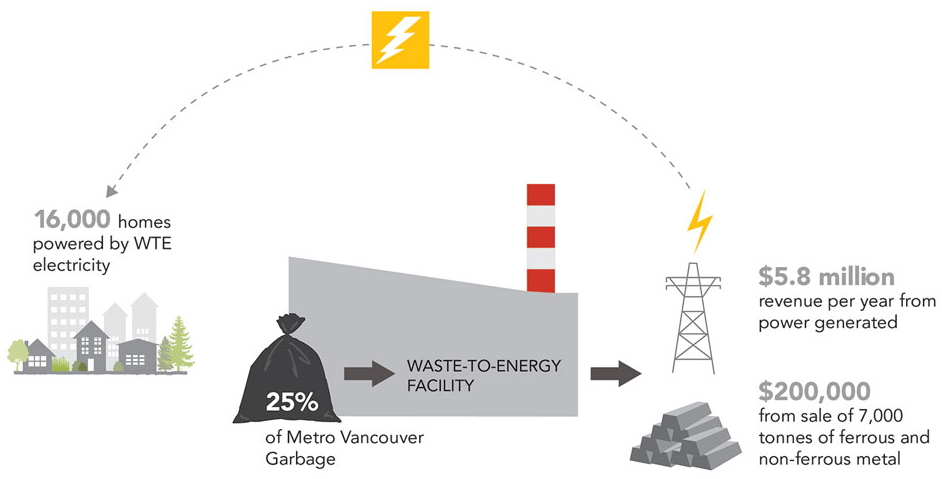
Illustrative 2018 annual revenue reference. Approximate electricity and metals figures from the 2018 operating year; the table below shows current 2024 results.
A growing metropolitan region needs a dependable destination for residual waste after reduction and recycling. Disposal capacity, transport distances and the cost of managing that waste all affect the service delivered to residents and businesses.
Burnaby’s industrial location brought waste treatment closer to the communities it served and placed a steam customer nearby. The development challenge was to connect a regional waste-management requirement with a productive local use for the recovered energy.
Over a long operating life, that challenge evolves. Customers can close, energy markets can change, and equipment needs renewal. An investment must account for how the facility will respond: where it can sell energy, which upgrades improve recovery, and how it will maintain environmental performance.
Build around local waste and useful energy
Metro Vancouver owns the facility, with Veolia providing operations and maintenance. Covanta forms part of its operating history. Waste is received primarily from Burnaby, New Westminster and the North Shore, making the plant part of the region’s wider waste-management system.
Deep operating history. The site was established in 1985 and began commercial operation in 1988, making it one of the first Canadian facilities to generate energy from municipal solid waste. Over 50 percent of the facility’s equipment is dedicated to air-pollution control.
The facility uses three mass-burn combustion lines. Our historical reference describes approximately 11 tonnes of waste per hour on each line. Heat produces steam, which can supply an industrial user or drive a turbine generator for electricity sales.
We report historical annual reference figures of approximately 250,000 tonnes of waste treated, 900,000 tonnes of steam produced and 132 GWh of electricity generated. Steam production is an intermediate energy stream; the facility produces electricity from that steam. These figures describe the historical operating reference and retain that basis.
Adapt the energy outlet as customers change
The original industrial steam relationship connected the facility to NORPAC. In 2003, a turbine generator enabled electricity sales to BC Hydro. Klean also records a C$7 million heat-recovery upgrade completed in 2006, illustrating continued investment in the asset’s productive capacity.
After the adjacent NORPAC mill closed, steam previously supplied to the mill was redirected into additional electricity generation. The change demonstrates the commercial value of having another route to market for recovered energy, supported by equipment and power-purchase arrangements.
For a new project, the lesson is to evaluate the heat customer, the electricity outlet and the consequences of losing either. The energy system and its contracts must work together over the plant's life.
Recover additional metals and maintain environmental controls
In 2018, an eddy current separator expanded recovery of non-ferrous metals such as aluminum and copper from bottom ash. An additional magnetic separator improved ferrous-metal recovery. Our historical reference reports approximately 7,000 tonnes of metal recovered annually, alongside a cumulative milestone of more than 5 million tonnes of waste processed.
The plant combines combustion control, flue-gas treatment and continuous emissions monitoring with independent stack testing and public reporting. Its provincial Operational Certificate sets the applicable requirements. Our reference also records process-water reuse with no liquid discharge to the sewer apart from sanitary facilities, and ISO 14001 environmental-management certification.
Recovered metals enter recycling markets. Remaining ash requires managed destinations, including treatment and testing of fly ash before disposal. This complete material pathway is part of the plant’s operating design and cost base.
A long operating record with visible commercial results
Burnaby’s history demonstrates how a waste-treatment asset can remain useful through successive changes in equipment, customers and operating arrangements. Its established electricity sales and metal recovery provide tangible offsets to regional waste management costs.
Environmental performance is continuously measured and publicly reported. Strict control over combustion conditions plus state-of-the-art air-pollution-control technology keep emissions a small percentage of total Metro Vancouver emissions, with no measurable impact ever found. The plant operates up to 98 percent below Operational Certificate limits, submits monthly reports to the Province, the City of Burnaby and the Fraser Health Authority, and undergoes independent stack tests three times a year. The Lower Fraser Valley Air Quality Monitoring Network continuously monitors ambient air at 30 sites.
The facility’s electricity output can power about 16,000 homes. Metro Vancouver earns about $8 million from electricity sales and $300,000 from recycled metal sold to a reinforcing-steel producer, and it historically sold a portion of the steam to NORPAC. In 2020, the facility avoided emissions equivalent to 35,000 passenger vehicles for a year or burning 82 million kilograms of coal, and it diverted 32,678 garbage trucks from landfill.
The most recent financial year retained in our reference provides a clear example. Metro Vancouver's 2024 financial report, the latest published update, dated September 2025, records the following results in Canadian dollars:
| Historical financial measure | Reported result |
|---|---|
| Municipal solid waste processed | 243,168 tonnes |
| Total expenditure including ash management and debt charges | C$33,616,947 |
| Metro Vancouver's electricity revenue | C$3,649,146 |
| Metro Vancouver's metals revenue | C$291,477 |
| Special-handle-waste revenue increment | C$1,620,343 |
| Expenditure per tonne before those revenues | C$138.25 |
| Revenue offset per tonne | C$22.87 |
| Net generator-repair settlement adjustment | C$16.35 per tonne |
| Net unit cost after revenue and generator-repair settlement adjustments | C$99.02 per tonne |
Tipping-fee revenue was accounted for separately. The 2024 result was affected by the 2023 turbine-generator failure, which reduced electricity revenue until the unit returned to service in July 2024. Metro Vancouver treats the net generator-repair settlement (insurance recoveries net of repair costs) as a separate C$16.35 per-tonne adjustment, and the revenue offset per tonne includes incremental special-handle-waste revenue in 2024. This historical result shows how recovered products contributed to the municipal service economics; project-specific costs and revenues require their own assessment.
A platform for further energy use
The facility’s evolution also creates a district-heating opportunity. Metro Vancouver’s district-energy development targets heat and hot water for up to 50,000 homes at full build-out. This planned use of recovered heat extends the original idea of connecting a waste-treatment plant with nearby energy demand.
Our historical case reports a lifecycle comparison of 0.7 tonnes of net CO₂e avoided per tonne treated relative to landfilling. That comparison depends on the landfill and energy assumptions used. The practical development task is to evaluate waste treatment, energy recovery, recycling, and residual disposal within the same project boundary.
The facility’s record includes recognition from SWANA and engineering, energy, and municipal organizations. Its lasting lesson is the importance of continued investment, documented performance, and an energy strategy that can evolve with the community.
Strict control over combustion conditions minimizes emissions, and continuous environmental monitoring confirms the facility operates well within its regulated limits.
1. Design for a useful operating life measured in decades.
Burnaby combines a long service history with successive energy and metal-recovery upgrades. Equipment renewal and market access belong in the investment plan from the outset.
2. Give recovered energy a durable route to market.
The transition from paper-mill steam supply to additional electricity generation shows why customer resilience and alternative energy outlets matter.
3. Make resource recovery count in the economics.
Historical offsetting revenues totaled C$22.87 per tonne of reported expenditure. Evaluate those revenues alongside treatment, maintenance, ash management, and financing costs.
These takeaways highlight selected lessons from this case study, not an exhaustive account. Klean brings deeper technical expertise and commercial insight to each project through tailored engagements.
Build the business case for turning your residual waste into steam, electricity, and lasting value.
Burnaby’s operating history shows why the customer for recovered energy belongs in the plant design from the start. Before you commit to a site, plant capacity, or an energy contract, establish how your waste supply, equipment, and energy markets will work together.
Klean combines thermal conversion technology, equipment integration and project development experience to define that pathway. Tell us your location, waste type, annual tonnage, site status and intended customers for steam, heat or electricity.
For suitable new equipment projects, our paid Detailed Equipment Quotation (DEQ) establishes the preliminary process configuration, equipment scope, and budgetary basis for your next investment decision. Further development progresses through a Detailed Feasibility Study (DFS) and Front End Engineering Design (FEED). Existing facilities can begin with a scoped paid assessment of energy recovery, efficiency, or upgrade opportunities.
Start Your Waste-to-Energy Project Evaluation Today >> GO.
ABOUT THE INFORMATION PRESENTED
This case study combines our historical reference information with published owner, operator, and regulatory records. Historical operating figures, the financial example, and district-energy development targets retain their respective bases. We address detailed project scope and confidential technical or commercial information through an agreed engagement with Klean.
The case connects with Goals 7, 8, 9, 11, 12, 13 and 15 through energy recovery, skilled employment, industrial infrastructure, urban waste services and improved resource management. Its central contribution is the continued productive use of residual waste within a regional system.
