
Colorado River Water Decision Will Impact Millions Across the American West
Post-2026 Colorado River Management
The federal government is poised to announce a major decision about the fate of the shrinking Colorado River — a crucial water supply for 40 million people across two countries, seven states and 30 tribes.
Over the past few decades, the worst drought in at least a millennium has parched the Western landscape and caused reservoirs to dwindle. A historically warm and snowless winter reduced this year’s flow to a trickle. Water levels behind two of the nation’s largest dams are in danger of dropping so low that the dams stop functioning.
At the same time, 19-year-old regulations for managing shortages in the basin are due to expire at the end of this year — and the river’s disparate users have been unable to agree on a rescue plan.
Now it falls to the Bureau of Reclamation, a little-known agency within the Interior Department, to find a way to stave off complete collapse. Officials are expected to announce a new strategy for operating the river sometime this summer.
The agency’s decision could trigger dramatic cuts that disrupt Western economies and potentially provoke states to take legal action to try to preserve their water access — such as suing each other or the federal government. Experts say the effects are likely to reverberate far beyond the Southwest.
Here’s everything you need to know about how the river reached this point, and what could happen next.
What is the Colorado River Basin, and who depends on it?
The 1,400-mile river originates in the Rocky Mountains of Colorado and courses through Utah, Arizona, Nevada and California before fanning out into a delta in northwestern Mexico. Because humans now use so much of the water, most of the time the river no longer reaches the sea.
The broader Colorado River Basin encompasses all of the river’s tributaries as well as the mountain lakes and snowpacks that feed them. It spans some 250,000 square miles across the West, including the glacier-capped peaks of Wyoming and the towering cliffs and rugged plateaus of New Mexico.
The river is also home to the two largest reservoirs in the country: Lake Powell, which sits behind the Glen Canyon Dam on the Utah-Arizona border, and Lake Mead, which is blocked by the Hoover Dam at the border between Arizona and Nevada. In between these behemoths, it winds through the Grand Canyon, which it carved over millennia from desert stone.
Roughly 1 in 10 Americans draw water from this basin, including residents of major cities like Denver, Las Vegas, Los Angeles and Phoenix. The basin is also home to 30 Native tribes, though many of them are unable to fully access water from the river because of disputes over their rights or a lack of necessary infrastructure.
The overwhelming majority of river water — roughly 75 percent of direct human use — goes to agriculture, primarily for irrigating feed crops for cattle. Some 5.5 million acres of farmland are irrigated from the Colorado.
How is the water in the river allocated?
The fundamental principle governing the Colorado River is known as “first in time, first in right.” In other words, the earlier someone started using water from the river, the higher their priority if supplies run short. More junior users, which include several large cities and newer farming areas, are the first to see reductions during dry spells. These users could theoretically lose their entire allocation before more senior rights holders are forced to make any cuts.
Over the years, a patchwork of treaties, laws, court rulings and interstate agreements has emerged to enforce this principle. At the center of this byzantine system sits the 1922 Colorado River Compact, which divvied up the river’s water between the Upper Basin states of Wyoming, Colorado, Utah and New Mexico and the Lower Basin states of Arizona, Nevada and California.
Under the compact, the Upper Basin is obligated to ensure that an average of 7.5 million acre-feet of water (enough to supply roughly 22 million homes) flows to the Lower Basin each year. Both basins are also responsible for delivering 1.5 million acre-feet to Mexico.
Though Native American tribes technically have some of the most senior rights on the river, as they have used its water since long before the United States even existed, they were not included in the negotiations over the compact. Most have had to go to court to establish how much water they are entitled to use, and several still don’t have their rights quantified, said tribal water law expert Heather Tanana, a citizen of the Navajo Nation.
Just how bad are the current shortages?
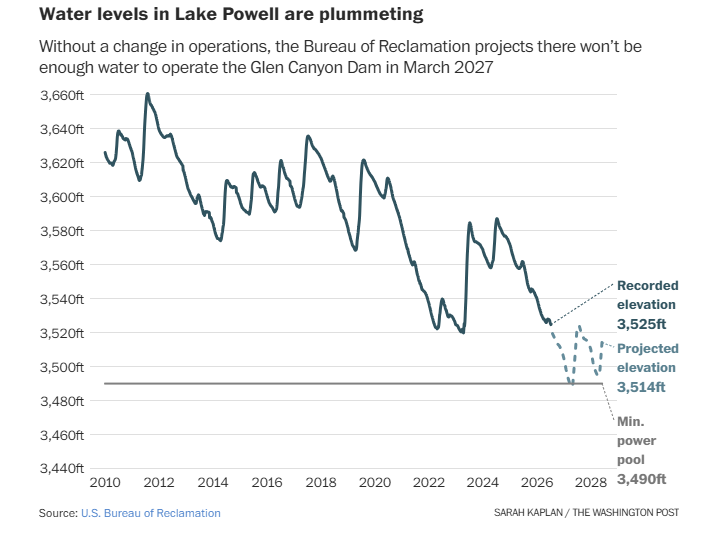
When the Colorado River Compact was negotiated, states assumed that roughly 18 million acre-feet of water would flow through the basin each year. In reality, experts say, the river almost never has contained that much water — and climate change has depleted flows even further. Higher temperatures caused mostly by burning fossil fuels cause snow to melt early and evaporate before it reaches the river. Heat also dries out soil and increases the water demand from crops and ecosystems.
Since 2000, research shows, Colorado River flows have been about 30 percent less than in the early 20th century, when the compact was negotiated. Human uses of river water have exceeded supply by an average 1.5 million acre-feet. This overuse was sustained by drawing down water stored in Lake Powell and Lake Mead, which are both at less than 30 percent of capacity.
Lake Powell is in particular danger — if water levels fall another 35 feet (roughly equal to how much they have dropped since last year) the dam will no longer be able to produce hydropower. If that happens, the only way to release water from the reservoir will be via secondary outlets that weren’t designed for long-term use.
Even before this year’s record-low snowpack, many in the region have had to cut back on their water use.
In the Upper Basin, where most water is drawn from the natural flow of the river, rather than from reservoirs, lower flows have shortened irrigation seasons and forced drought restrictions in cities. After shrinking reservoir levels prompted the Bureau of Reclamation to declare the first-ever shortage on the river in 2021, the three Lower Basin states agreed to curb their consumption by about 10 percent. In exchange, the federal government allocated billions of dollars for conservation measures, including paying farmers to fallow their land.
Now that money is running out. The reservoirs have almost been tapped dry. And a record-low snowpack means there’s less water flowing into the river than ever before.
“This is the year when everything is coming to a head,” said Doug Kenney, director of the Western Water Policy Program at the University of Colorado. “It’s an ‘out of the frying pan and into the fire’ situation.”
Why can’t the states agree on a solution, and what has been proposed?
It’s apparent that existing rules for managing shortages have failed to prevent chronic overuse, and nearly everyone agrees that new guidelines are needed to ensure that reservoirs can keep operating and essential water sources don’t run dry.The sticking point: Who should bear the pain of deeper cuts?
Under the soon-to-expire rules, Lower Basin states are required to slash their water use when reservoir levels fall below a certain threshold. This time around, those states want the Upper Basin to agree to mandatory reductions as well. But officials in the Upper Basin counter that they have always cut back during dry years, because they don’t have excess storage in large reservoirs to fall back on.
The two biggest reservoirs on the river, Lakes Powell and Mead, are located in the Lower Basin — giving users in Arizona, California and Nevada a buffer from dry spells that isn’t available elsewhere in the watershed. If cuts are needed to stabilize these reservoirs, Upper Basin officials say, the burden should fall on the states that draw from them.
It may not help that every state in the basin apart from Utah has a governor’s election scheduled for this fall, creating little incentive for local politicians to seek regional compromise.
“The reality is people view these allocation amounts as something that was promised to them — something that is the birthright of the states and an essential part of the legacy of each state — and it’s not something to be compromised on,” Kenney said.
Amid these deadlocked negotiations, the three Lower Basin states in May put forward a stopgap proposal that they said could save 1.25 million acre-feet of water per year, largely by using federal funds to pay some users to forgo their annual allotment. But that’s only about half of what many scientists say is needed to stabilize the river.
If Kenney were “king for a day,” he said, he would simply calculate the percentage gap between water supplies and demand, and then reduce everyone’s allocation by that amount — sharing the pain of shortfalls equally across the basin.
But as long as the Law of the River guarantees certain water rights and prioritizes certain users, Kenney said, it will be hard to create a political appetite for that kind of solution.
What do we know about the Bureau of Reclamation plan?
With no basin-wide agreement to guide it, the agency is set to impose its own guidelines for future operations of the Colorado River reservoirs. Since Lake Powell and Lake Mead are in the Lower Basin, the bureau’s decision will inevitably have the greatest impact on those states.
Acting commissioner Scott Cameron has said the agency is looking at adopting a 10-year framework that would be reassessed every two years. It’s not an ideal scenario for most users, who would prefer a longer-term plan with more certainty about how much water they can expect in coming years. But it’s necessary given the stalemate among the states, Cameron said.
“If peace breaks out and we have a seven-state agreement on something … we’re happy to take that agreement and have it supplant this 10-year framework,” he told a gathering of water officials in Boulder this June.
Arizona’s chief negotiator told Reuters this month that the bureau was considering adopting much of the Lower Basin’s proposal, which the states hope will spare them from steeper unilateral cuts.
In an emailed statement, a Bureau of Reclamation spokesperson said that the agency was still finalizing its plan for operations of the basin, and that officials hope it will provide stability while leaving room to incorporate any future compromises the states are able to achieve.
What are the coming consequences?
If major reductions are coming, experts say, Arizona will probably be hit the hardest, since it is home to some of the most junior rights holders on the river.
This region has grown accustomed to extreme conservation measures, said Sarah Porter, director of the Kyl Center for Water Policy at Arizona State University — since 2022, the state has reduced its annual use of Colorado River water by as much as 950,000 acre-feet. But depending on how deep the Bureau of Reclamation cuts end up being, they could exhaust communities’ backup supplies and send a shock through the state economy.
“We would be in a whole different world,” Porter said.
The consequences are likely to be felt far beyond the West. The vast majority of winter vegetables consumed in the U.S. come from farms in Arizona and California that are irrigated from the Colorado; major cuts in those areas could lead to price hikes across the country. The river supplies water to 11 national parks along with a variety of other public lands, generating billions of tourism dollars. Water shortages could also affect economically and geopolitically significant industries such as semiconductor producers and copper mines in Arizona.
Severe cuts may also prompt Lower Basin states to sue the federal government or the Upper Basin states; the Arizona legislature has already created a multimillion-dollar Colorado River litigation fund in preparation for that possibility. Meanwhile, any effort to more evenly distribute reductions seems just as likely to trigger a lawsuit from senior rights holders or Upper Basin states.
Experts say it appears increasingly possible that the Supreme Court will wind up deciding the Colorado River’s future — a scenario states were once desperate to avoid.
“There’s a fair number of people who say leaving these decisions to the states hasn’t worked,” Kenney said.
He continued: “Once you’re resigned to the fact that the only outcomes are pain and suffering, the only question is how much pain and how it’s distributed. Then if you’re a state the thinking is, well, it’s better to let the feds take the hit.”
You can return to the main Market News page, or press the Back button on your browser.
