
Sustainable Development Goals


PROJECT INFORMATION AT A GLANCE:
Giving recovered tire textile fiber a valuable construction application
Project Status:
Completed feasibility study and project-development work
Organizations Involved:
Klean Industries, University of British Columbia, Atlantis Holdings, Liberty Tire Recycling / Western Rubber Products, Tire Stewardship British Columbia, Lafarge/Holcim, BASF and CECEP
Services / Equipment:
Feasibility Studies, Due Diligence, Carbon Management
We saw a commercial opportunity in one of tire recycling’s least-valued outputs: the textile fibers that help give a tire its strength. Its work on recycled tire fiber reinforced concrete examined how this recovered material could become a performance additive for construction, creating a new outlet for recyclers and a practical reason for concrete producers to use recycled content.
The technical evidence gives that opportunity substance. A published UBC mortar study recorded a 97.5% reduction in plastic-shrinkage crack area with recycled tire fibers compared with the plain reference mix. Our project record also identifies fiber-recovery energy use at approximately one-fifth of virgin polymer-fiber production. The commercial proposition combines useful material performance with a less resource-intensive source of reinforcement.
The Challenge
Unlock the value in a difficult tire-recycling fraction
A tire contains more than rubber and steel. Its textile reinforcement also becomes a recovered material stream, often with fewer valuable outlets. Finding an application that pays for its useful properties can improve the commercial case for recovering more of the tire.
Concrete presents a compelling match. Cracking creates maintenance demands, and manufacturers already use fibers to control shrinkage and improve material behavior. A recovered fiber that performs this function can compete on the needs of the construction customer as well as its recycling credentials.
The challenge was to connect those two industries. The material had to be suitable for processing, mixing and placement, while the business needed dependable supply, a defensible technology position and customers willing to adopt it. Our feasibility work brought those technical and commercial questions into the same assessment.
The Solution
Connect the recovered material, the research and the market
We engaged with Atlantis Holdings, UBC, Liberty Tire Recycling’s Western Rubber Products operation, Tire Stewardship British Columbia and CECEP to undertake a Detailed Feasibility Study of Atlantis Holdings’ technology, intellectual property and product applications.
The work extended into implementation discussions in China, Taiwan, the United States and the United Kingdom. Our role was to assess the opportunity and connect it with industrial and commercial participants, building on research undertaken by UBC and the material-development work of Atlantis Holdings.
Put the tire’s textile reinforcement to work again
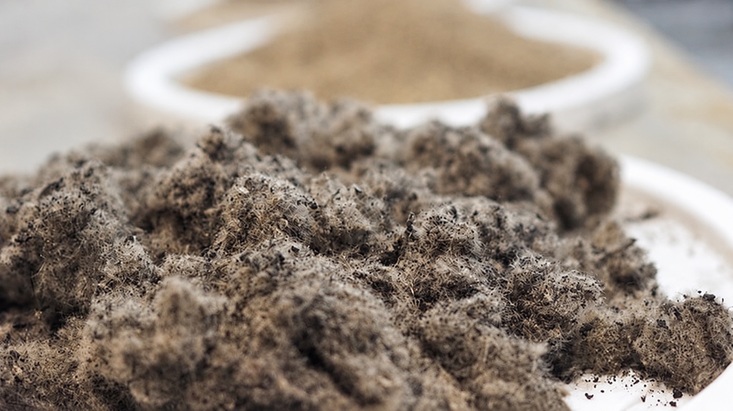
The application uses recovered polymer fibers as a secondary reinforcement within a cementitious mixture. Distributed through the mix, fibers can bridge developing cracks and limit their opening. Fiber selection, cleaning, dispersion and dosage influence how effectively the material performs.
In the published UBC study, a 0.4% scrap-tire-fiber dosage reduced plastic-shrinkage crack area in mortar by 97.5%. The commercial PET-fiber comparator achieved 99.4% at a 0.3% dosage. The comparison demonstrates substantial crack control from recovered material under the study conditions, with formulation-specific performance rather than a universal mixing prescription.
Read the UBC research on recycled tire fibers and mortar durability »
Build a product proposition around performance and resource efficiency
Our assessment identified opportunities in crack and shrinkage control, flexural performance and complementary reinforcement. It also reports benefits involving permeability, bleeding, impact and abrasion resistance, mix cohesion, pumpability, and fire and freeze–thaw performance. Those properties expand the range of potential applications and are assessed against the selected fiber blend, concrete mix and exposure conditions.
The energy comparison adds another commercial dimension. Recovering tire-derived fibers requires approximately 20% of the energy associated with producing virgin polymer fibers on the project’s comparison basis. This is a fiber-production comparison; the energy and carbon performance of the finished concrete also depend on its cement content, mix design, transport and service life.
For a recycler, the opportunity is an additional market for a difficult recovered fraction. For a concrete producer, it is a source of functional reinforcement that can reduce reliance on virgin fiber. For an infrastructure owner, better crack control offers a route toward lower maintenance demand, subject to the specified application’s performance.
The Outcome
A completed commercial assessment backed by relevant material research
We completed feasibility and project-development work around the technology and its market opportunity. The assignment connected tire recovery, intellectual property, construction-material performance and international implementation discussions. It established a commercial framework for evaluating how a recovered fiber could become a specified construction input.
The wider research program also moved into practical applications. UBC used recycled tire fibers in resurfacing work on campus steps and monitored the material’s behavior. Atlantis describes this work as a thin mortar repair application at the H. R. MacMillan Building.
At Chawathil First Nation, a separate UBC pavement demonstration incorporated scrap tire fibers, cellulose fibers and other recycled materials. The community reports that 30 solar-powered sensors were embedded to monitor the pavement. These research installations provide application experience alongside laboratory results; our contribution in this case was the feasibility and commercialization work.
The next source of recycling value may be a material already being recovered
The business insight is larger than a single concrete mix. A material with limited value in one industry can become useful to another when its properties, preparation and application are understood. In this case, the tire’s textile fraction offered a route into an established market for concrete additives.
Our work also identified what influences adoption: construction-sector acceptance, application-specific evidence, delivered cost, reliable supply and protection of intellectual property. Addressing those issues together helps turn promising material research into a credible commercial proposition.
1. A low-value tire fraction can become a performance product. Recovered textile fiber offers an additional construction-material outlet alongside the tire’s rubber and steel streams.
2. The opportunity has meaningful technical and resource data. A UBC mortar study recorded 97.5% less plastic-shrinkage crack area; our project record identifies fiber-recovery energy use at approximately one-fifth of virgin polymer-fiber production.
3. We connect research with the requirements of a business. Completed feasibility work examined the technology, intellectual property and product applications, supported by international market-development discussions.
These are selected achievements and lessons. Further technical and commercial insights are available through an engagement with Klean.
WHAT DO THESE LESSONS MEAN FOR YOUR PROJECT?
If you recover tire fibers, manufacture concrete products or hold a material technology with commercial potential, we can help assess the connection between feedstock, processing, performance and customer demand. The objective is to identify an application in which recovered material creates value that a customer is prepared to purchase.
Material-development, intellectual-property and market-entry assignments can be scoped as paid feasibility or due-diligence engagements. Where new processing equipment is required, the development pathway begins with a paid Detailed Equipment Quotation (DEQ), progresses through a Detailed Feasibility Study (DFS) and then Front-End Engineering Design (FEED).
Discuss Your Recovered Fiber and Construction Materials Project with Klean >> GO.
Https://vimeo.com/1053280072
ABOUT THE INFORMATION PRESENTED
This case combines our project record with published research and descriptions of related demonstrations. Performance figures relate to the identified materials and assessment conditions. A commercial application is developed around its own feedstock, formulation, specifications and customer requirements.
Please review the report “Sustainability Driven: Accelerating Impact with the Tire Sector SDG Roadmap”.
