
Sustainable Development Goals



PROJECT INFORMATION AT A GLANCE:
Project Status:
Operational application-development programme
Organizations Involved:
Klean Industries, HSC Colorants, Colorant Buyers
Services / Equipment:
Feasibility Studies, Due Diligence, Supply Chain Management, Carbon Management
A waste-tire-derived carbon stream becomes commercially interesting when an industrial customer can use it to achieve a defined result. Our collaboration with HSC Colorants demonstrates that principle in decorative concrete: the original project account reports a uniform, deep-black finish with a subtle blue undertone, sustained color appearance under weathering, and lower pigment material costs. The achievement is not simply recovering carbon, it is developing a marketable colorant for an established construction-material application.
The case illustrates a route to recovered-carbon value beyond conventional rubber reinforcement. Concrete and cement colorants have a different product proposition: appearance, dispersion, application performance, delivered cost and reliable supply. Our work with HSC brought carbon recovery and specialist pigment knowledge together around those customer requirements.
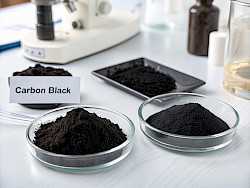 Raw tire-pyrolysis char varies with the feedstock and process. The characteristics required by concrete colorant formulators cannot be assumed from carbon content alone. A buyer needs confidence that the chosen material can deliver consistent shade, disperse in a cementitious mix, withstand the intended service environment and arrive at a commercially competitive cost.
For a project developer, this is a market-entry problem as much as a processing problem. An unqualified carbon stream may have nominal value, but its price and accessible customer base depend on whether it can be developed into a reliable product. The correct target is the finished colorant application, not simply the output of a pyrolysis reactor.
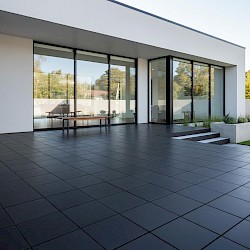 we collaborated with HSC Colorants, identified in the original project as the specialist European colorant partner, to develop rCB-based colorants for concrete and cement applications. We brought its recovered-carbon and commercial-development experience; HSC contributed pigment and application know-how. The original project identifies colorant buyers as part of the commercial network.
This collaboration linked the starting carbon material to the requirements of a specific end use. Rather than treating every char or rCB grade as interchangeable, the project focused on the suitability of the prepared carbon product for decorative concrete. Color strength, uniformity, visual undertone, durability and cost became the measures of whether the product could compete.
Demonstrate the product in decorative concrete.
The application example described on our existing page reports three commercially significant outcomes:
The page does not provide numeric color measurements, weathering duration, comparative costs or test methods. These are reported project results, not universal performance specifications for all rCB and concrete formulations.
Why this matters: the project links a recovered material to a specifier-visible result and a buyer-relevant cost outcome. That is the point at which waste recovery becomes product commercialization.
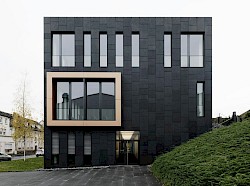 Working with HSC, we demonstrated an application route for appropriately prepared recovered carbon in the construction colorants market. The original account reports that the decorative-concrete example met the desired visual effect, retained color appearance in the observed conditions and reduced pigment costs. It shows the value of matching carbon preparation to an end-user application instead of relying on a generic rCB commodity description.
The project also supports an important portfolio-level lesson: not every tonne of recovered carbon must compete for the same tire or rubber customer. Suitable material can be qualified for different industrial users, creating additional potential outlets and allowing projects to design their carbon-upgrading approach around actual demand. The usable share, selling price and economics must still be established for each material and buyer.
Our recovered-carbon journey began with technology and application testing in 2003. This HSC development program represents a specific collaboration within that wider body of application and commercialization work. The lasting value is our ability to connect the carbon-production side with the language, specification and buying decisions of downstream industrial customers.
1. Value is created at the customer specification.
The concrete example demonstrates a market proposition based on shade, consistency, durability and delivered cost, not raw char tonnage alone.
2. Specialist partners shorten the route from material to application.
Our collaboration with HSC connected recovered-carbon development with colorant know-how and prospective buyers.
3. Market diversification matters.
A concrete colorant application offers an additional potential outlet for qualified rCB, reducing dependence on any single carbon-product market when supported by real customer demand.
These are selected achievements and lessons; further technical and commercial insights are available through an engagement with Klean.
If your tire-pyrolysis project plans to sell carbon, the first question should be who will buy the finished material and against what specification? We can help evaluate the starting material, realistic upgrading pathways, application development and commercial opportunities before equipment decisions lock in a product that buyers cannot use.
For new facilities, this work can begin through a paid Detailed Equipment Quotation (DEQ), then progress through a Detailed Feasibility Study (DFS) and Front-End Engineering Design (FEED) as appropriate. Existing carbon streams and customer-development assignments may require a separately defined technical or commercial scope.
Discuss Your Recovered Carbon Black Colorant Project with Klean >> GO.
Learn More:
ABOUT THE INFORMATION PRESENTED
This historical application-development case summarizes our reported collaboration and decorative-concrete results. Product performance and cost outcomes relate to the materials and conditions of that project; individual formulations, specifications and commercial terms are addressed through an appropriate engagement and confidentiality arrangements.
This project addresses the United Nations Sustainable Development Goals (SDGs) by considering the goals and associated targets illustrated by the WBCSD’s Tire Industry Project (TIP). TIP provides a framework for action that outlines impactful pathways for the tire sector to contribute to achieving the Sustainable Development Goals (SDGs). To learn more about how our approach, solutions, and technologies contribute to advancing the SDGs, please review the report “Sustainability Driven: Accelerating Impact with the Tire Sector SDG Roadmap”.
