
Sustainable Development Goals


PROJECT INFORMATION AT A GLANCE:
Project Status:
In development
Organizations Involved:
Klean Industries, KBR, Viva Energy, CEVA Logistics, CMA CGM, InvestVictoria, Sustainability Victoria, Tyre Stewardship Australia, Several Tyre Recycling Companies
Services / Equipment:
Design and Engineering; Feasibility Studies; Supply Chain Management
CEVA handles the importation of 52% of Australia’s new tyres, more than 25 million tyres annually. Klean is connecting that distribution capability with end-of-life collection, recovered carbon black for tyre manufacturers and a refinery pathway for lower-carbon fuels. The flagship connects CEVA’s collection and distribution services with tyre manufacturers that buy recovered carbon black, and with Viva Energy, which provides the refinery pathway for recovered oil.
Klean intends to own the Melbourne project. With CEVA Logistics and Goodpack handling material movements, KBR providing engineering, procurement, and construction management, and Viva Energy developing the refinery connection, the project brings together the industrial relationships needed to make circular tire recovery work at scale.
“This partnership with Klean Industries is an important development for Viva Energy as we continue to explore new pathways to a more sustainable future for our refinery. By transforming end-of-life tyres into valuable resources, we are not only reducing waste but also pioneering new paths for low-carbon fuel production. This project demonstrates our determination to develop a circular economy and deliver environmental and economic benefits for the community.”
— Lachlan Pfeiffer, Chief Strategy Officer, Viva Energy
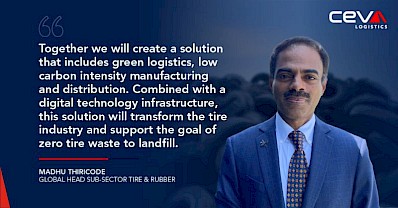 Every recycling plant depends on a reliable, economically viable supply of feedstock. Klean’s collaboration with CEVA and Goodpack starts with the network already moving new tyres for major brands and gives it a second purpose: returning end-of-life tyres for resource recovery.
CEVA, the world’s largest new-tyre distributor, serves major tyre brands across 65 countries. Its distribution network moves more than 600 million new tyres annually. Globally, over 1.5 billion tyres reach the end of their lives each year. Klean sees the potential to use reverse logistics with CEVA to address approximately one-third of that global stream—an opportunity on the order of 500 million end-of-life tyres annually.
Australia provides a compelling starting point. CEVA’s responsibility for more than half of new-tyre imports ties the project to a substantial existing flow of products, customers, and transport movements. Reverse collection can make use of return journeys, while Goodpack’s reusable tyre boxes support handling, storage, and containerized transport through distribution centers and international shipping networks.
The Klean–CEVA–Goodpack agreement announced in April 2023 established the framework for that global collaboration, beginning with an Oceania proof of concept. Melbourne is the flagship application of a model with much broader reach.

The commercial loop becomes clear at the tyre factory: CEVA can deliver Klean’s recovered carbon black when collecting the manufacturer’s new tyres for distribution. The tire manufacturer purchases the rCB and supplies the new tires for distribution; CEVA provides the logistics to connect those movements.
New tyres move through the distribution network. End-of-life tyres return via collection logistics. Klean’s plant recovers carbon, oil and steel, and suitable recovered carbon black returns to manufacturers. Coordinating those movements offers an opportunity to improve freight utilization and reduce handling costs throughout the cycle.
Klean has secured offtake partners for 20,000 tonnes per year of recovered carbon black in the Australian development. The processing and carbon-upgrading systems are designed to meet the quality and consistency those customers require. CEVA’s distribution capability connects that production with the manufacturers who can use it.
This is why Klean develops feedstock preparation, pyrolysis, carbon upgrading and customer specifications in concert. The product must perform in the buyer’s application, and the supply chain must deliver it consistently.
CEVA’s parent company, CMA CGM, provides another important commercial connection. Ships serving international trade consume marine fuel, including when they call at Melbourne. Klean’s work with Viva Energy links recovered tyre oil to refinery infrastructure capable of producing fuels for those markets.
That pathway has already produced a tangible result. In July 2025, Viva Energy successfully co-processed 10 tonnes of tyre pyrolysis oil from Klean’s reference operation in Poland with conventional crude at the Geelong Refinery. The successful Geelong co-processing trial demonstrated the downstream route supporting the Australian development.
Klean has identified offtake for 25,000 tonnes per year of recovered fuel oil. Viva provides the refinery connection for that oil. CMA CGM represents a potential customer for the resulting marine fuel when its vessels call at Melbourne. The ships supporting the tyre supply chain could use fuel incorporating resources recovered from the tyres that supply chain moves.
The oil’s biogenic content is central to this opportunity. Biogenic content is the portion derived from biological material, primarily the natural rubber in tyres. Klean’s project basis identifies 35–40% biogenic content before modification, with modifications capable of increasing it to above 50%. These percentages refer to biogenic content, not the proportion of oil converted into diesel. Feedstock composition and the selected process configuration determine the outcome for each project.
The Viva Energy and Klean co-processing case study provides more detail on the refinery pathway.
KBR will be the Melbourne project’s engineering, procurement and construction management (EPCm) provider. This will connect Klean’s process technology and operating knowledge with the engineering and execution capabilities needed to deliver a major industrial facility.
The role builds on the exclusive Klean–KBR strategic alliance for TyreNova. Under the alliance, KBR leads global licensing, sales, marketing, engineering and delivery, while Klean provides technology innovation, technical leadership and project development.
For Melbourne, this brings processing technology, feedstock strategy and recovered-product requirements into a coordinated project-delivery structure. For future projects, the same alliance provides a path to deploy TyreNova internationally leveraging Klean’s integration experience and KBR’s global capabilities.
The environmental advantage of integration depends on what happens across the entire supply chain: collection distances, backhaul utilization, processing energy, product recovery and the materials or fuels displaced. KleanLoop provides the transparent data needed to substantiate Klean’s lowest-carbon-intensity proposition across that integrated system.
The KleanLoop tyre traceability platform connects material movements, energy use and emissions records on a blockchain. This creates an auditable record linking the tyres collected to the recovered products delivered, allowing carbon-intensity calculations to be traced to their underlying data and compared on a consistent lifecycle basis.
Klean’s alliance with Yokogawa adds industrial automation and process-data capabilities that support KleanLoop. Manufacturers, fuel customers and investors gain visibility into the performance of the products they purchase and the projects they support.
Klean has secured two development sites, with permit screening underway. The Melbourne facility is planned to have a proposed capacity of up to 80,000 tonnes annually, supported by product-market development for rCB and recovered oil. Investor funding discussions and grant applications are part of the development programme.
Klean’s Australian feedstock assessment identified the potential for six to eight Boardman-sized facilities or for twelve to sixteen facilities at the scale of the operating design used in Poland, with locations selected to meet local collection and customer needs. This highlights the opportunity to expand the model beyond the initial flagship.
Following its divestment of Boardman, Klean is concentrating its corporate ownership in Australia, where these connected commercial relationships give the project a distinct strategic advantage. The company’s global licensing and flagship-development strategy combines international deployment through KBR with selective ownership of projects where Klean can capture the value of integration directly.
Melbourne brings the tyre manufacturer, logistics network, recycling plant, refinery and potential marine-fuel customer into the same commercial cycle. Klean’s ability to connect those businesses is what gives this flagship its significance.
1. A major tyre distribution network can become a recovery network.
CEVA handles 52% of Australian new-tyre imports. Klean sees a global reverse-logistics opportunity covering approximately one-third of the more than 1.5 billion end-of-life tyres produced annually.
2. Industrial customers shape both the material and fuel pathways.
rCB deliveries can connect directly with new-tyre collections. The successful Geelong trial links recovered oil to refinery processing and creates an opportunity to serve marine-fuel demand.
3. Klean combines intended asset ownership with engineering and transparent performance data.
KBR’s EPCm role supports delivery, while KleanLoop provides the traceability needed to substantiate carbon-intensity performance across the system.
The Australian flagship connects CEVA’s logistics services with Klean’s processing, the demand from tyre manufacturers for rCB, and Viva’s refinery pathway to fuel markets. Klean brings the expertise to design those relationships into the project from the beginning.
For tyre manufacturers, logistics companies, refiners and investors, the opportunity is to participate in an integrated recovery business. For project developers, Klean’s paid Detailed Equipment Quotation (DEQ) establishes the preliminary equipment and commercial basis, followed by a Detailed Feasibility Study (DFS) and Front-End Engineering Design (FEED) as the project advances.
These are highlights from a broader body of project experience. A defined engagement applies that knowledge to your feedstock, location, customers, and investment objectives.
Discuss Your Project or Partnership Opportunity with Klean >> GO.
Learn More
ABOUT THE INFORMATION PRESENTED
This case study presents selected Klean development milestones, project figures, and commercial objectives. Melbourne remains in development; proposed capacities and global logistics potential outline the opportunity under development. Confidential technical and commercial information is shared within an agreed scope and with appropriate permissions.
This project addresses the United Nations Sustainable Development Goals (SDGs) by aligning with the goals and associated targets outlined by the WBCSD’s Tire Industry Project (TIP). TIP provides a framework for action that outlines impactful pathways for the tire sector to contribute to achieving the Sustainable Development Goals (SDGs). To learn more about how Klean’s approach, solutions, and technologies contribute to advancing the SDGs, please review the report “Sustainability Driven: Accelerating Impact with the Tire Sector SDG Roadmap”.
