Sustainable Development Goals




Project Status:
DECOMMISSIONED | Completed | Operational 1981 - 2001
Organizations Involved:
Mitsubishi Materials Corp, Onahama Smelting, Tototomi Sangyo, MIC, Klean Industries (IP & Know-how)
Services:
Design & Engineering, Turn-Key DBC, Due Diligence, Component Supply
Introduction
Klean Industries' whole tire hybrid gasification and pyrolysis technology has a Japanese commercial lineage extending to the early 1980s, supported by development dating to the 1970s. More than four decades of Japanese industrial heritage in whole tire conversion and resource recovery. Klean owns all of the technology's intellectual property and know-how, bringing this industrial heritage into its portfolio of proprietary resource recovery systems.
Developed to process end-of-life tires without shredding or chipping, the vertical kiln combines continuous whole tire feeding with integrated recovery of fuel gas, oil, steel and carbon-bearing materials. Its history demonstrates the depth of engineering and practical process knowledge behind Klean's position in tire recycling.
The Challenge
Tires combine energy-rich rubber, carbon and steel in a structure designed to resist damage. Recovering those resources at industrial scale requires dependable feeding, controlled thermal conversion and effective separation of the resulting products.
Shredding introduces electricity demand, cutting equipment and wear before thermal processing begins. Eliminating that step requires a plant capable of accepting whole tires while managing gas containment, material movement and continuous residue discharge. For an industrial energy user, the recovered fuel must also be cleaned, cooled and delivered in a form the receiving equipment can use.
The Solution
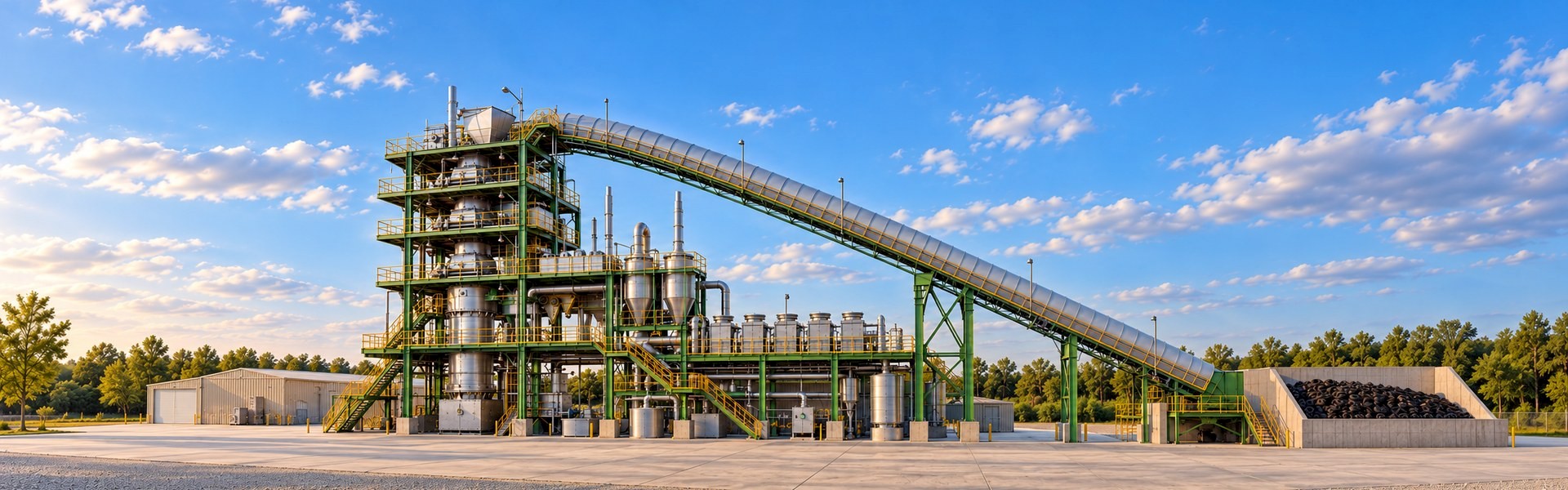
Klean's whole tire pyrolysis and gasification platform integrates whole tire handling, staged feed isolation, thermal conversion and product recovery within a vertical kiln arrangement. Tires are received, drained of retained water and conveyed to the top of the tower. Successive feed chambers meter material into the reactor while limiting unwanted air entry and gas release.
The hybrid process uses controlled partial combustion to supply heat for thermal decomposition. Following burner-assisted start-up, regulated air admission allows part of the tire feedstock to sustain the conversion process. This internally generated heat reduces the requirement for external heating fuel during stable operation.
The gas recovery train is central to the design. Cyclones remove entrained carbon, while staged heat exchangers cool the gas and recover condensable oil. Liquid separation and downstream gas conditioning prepare the recovered streams for storage or industrial use. The engineering drawings show these systems arranged alongside the kiln, with access platforms, material handling and service connections designed around the operating process.
Steel wire and carbonaceous residue leave through a water-sealed discharge system for subsequent separation and recovery. Processing tires whole preserves the steel reinforcement from shredding and removes the associated cutting stage from the preparation line. Centralized controls coordinate feeding, reactor operation, gas handling and discharge.
The wider engineering archive also includes parallel processing trains, further gas treatment and arrangements for energy use. These records demonstrate the scope of development behind the platform, encompassing the equipment needed to turn a thermal reaction into an integrated industrial operation.
The Outcome
The Japanese operating record includes a 1.5-tonne-per-hour plant that began operating in April 1981 and an enlarged plant, rated at 8 tonnes per hour, completed in June 1986 and operated until March 2011, and was shut down due to its close close proximity to Fukushima Daiichi that was damaged in the great earthquake on March 1, 2011. Onahama Smelting was among the industrial users. Recovered gas was transported through more than one kilometre of piping for use as an alternative industrial energy source.
This history connects whole tire processing with a practical industrial purpose: recovering useful materials and delivering fuel to an existing energy consumer. It also establishes a commercial lineage spanning more than four decades, supported by plant photographs, process documentation and detailed engineering drawings.
Klean's ownership of this technology preserves both the process design and the accumulated know-how required to apply it. That experience informs decisions about tire preparation, reactor selection, gas recovery, product quality and integration with the customer’s operation. It is this combination of technology ownership and industrial understanding that underpins Klean's leadership in advanced tire recycling.
Learn More
Klean Industries combines proprietary technology with the engineering and project development knowledge needed to connect tire supply, processing performance and product demand. Share your feedstock, capacity and product objectives with the KleanTeam to begin evaluating the right technology and development pathway for your project.
Submit Your Project for Evaluation >> GO.
