
Sustainable Development Goals



Project Status:
Development Started 2023 | Feasibility Study | Pre-FEED
Organizations Involved:
Klean Industries, Bridgestone, Tokai Carbon, ENEOS, LanzaTech, Grupo BB&G, Versalis
Services:
Consulting Services, Due Diligence, Supply Chain Management,
Integrated tire manufacturing, retreading, and pyrolysis are key components in creating a circular economy for tires, reducing raw material demand, lowering emissions, and maximizing resource recovery.
The Challenge
 Japan generates approximately 1 million tonnes of end-of-life tires (ELTs) annually, over 90 million individual units, making it one of the largest tire-consuming nations in Asia. While Japan has historically maintained high recovery rates through thermal recycling and material repurposing, the majority of ELTs are still incinerated for energy or shredded for civil engineering use, falling short of true circularity.
With rising demand for sustainable mobility, increasing global pressure to reduce greenhouse gas emissions, and growing interest in resource independence, Japan’s tire industry faces a critical challenge: how to move beyond downcycling toward a closed-loop tire recycling ecosystem that aligns with Japan's carbon neutrality goals.
The Solution
To address this, Bridgestone Corporation, Japan’s leading tire manufacturer, has launched its boldest sustainability initiative to date: EVERTIRE. Announced in January 2025, the EVERTIRE concept reimagines tires as products with endless life cycles—engineered not just for performance but for retreading, material recovery, and reintegration into new tire production.
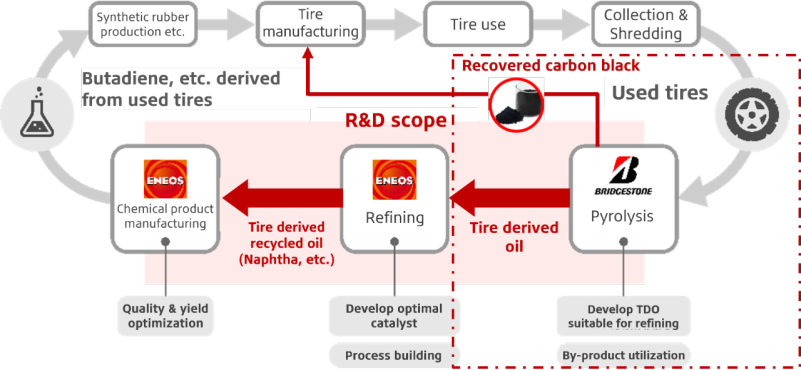
At the heart of this initiative is the integration of advanced tire pyrolysis technologies into Bridgestone’s domestic operations. This allows valuable materials such as Recovered Carbon Black (rCB) and Tire Pyrolysis Oil (TPO) to be extracted from ELTs that are no longer suitable for retreading, creating the foundation for true tire-to-tire recycling.
For more information about this project, please see the Bridgestone website >> GO.
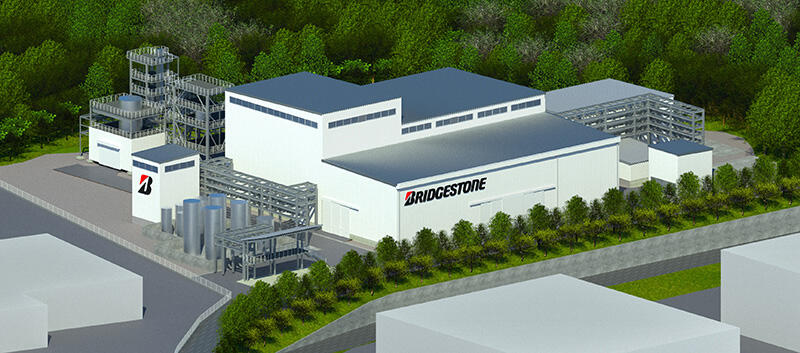
The rendering above shows the pilot demonstration plant for the precise pyrolysis of end-of-life tires, with a processing capacity of approximately 7,500 tons per year.
Key Technologies and Focus Areas of EVERTIRE:
The Outcome
Bridgestone’s EVERTIRE initiative represents a significant step forward for Japan’s circular economy, establishing a model for harmonizing retreading, advanced recycling, and smart manufacturing under a single regenerative value chain.
Project Milestones and Impact:
Pilot Integration: Bridgestone has begun the first stages of integrating pyrolysis equipment at Japanese tire manufacturing and retread facilities to enable localized, high-value material recovery.
This approach goes far beyond conventional recycling. By combining tire design innovation, retreading, and material recovery through pyrolysis, Bridgestone is building the world’s first closed-loop tire manufacturing system on home soil in Japan.
Conclusion
Japan is emerging as a global leader in next-generation tire recycling through Bridgestone’s EVERTIRE initiative. By transitioning from traditional ELT disposal methods to an integrated, circular system, Japan is poised to achieve full tire-to-tire circularity by reusing casings when possible and recovering core materials when not.
This vision not only supports national climate and resource efficiency goals but also sets a precedent for how the global tire industry can evolve toward scalable, sustainable solutions, starting with retreading, powered by innovation, and completed by pyrolysis.
Primary Contacts regarding this project:
If you would like to learn more about this project, please get in touch with us now >> GO.
