
Sustainable Development Goals



PROJECT INFORMATION AT A GLANCE:
Project Status:
Detailed Feasibility Study completed
Organizations Involved:
CMA CGM Group, CMA CGM Fund for Energies, CEVA Logistics and Klean Industries
Services / Equipment:
Detailed Feasibility Studies, Plant Design & Engineering
We completed a Detailed Feasibility Study (DFS) for CMA CGM Group, CEVA Logistics’ parent company, on taking distribution warehouses fully off-grid. An illustrative operating-day model for a 75,000 m² roof could supply 20 empty-to-full refuelings of the Toyota-powered VDL trucks used in European parts logistics, while also powering the warehouse.
Modeled fleet dispatch: 20 Toyota-powered VDL trucks × 39 kg per full fill = 780 kg of hydrogen.
The design called for rooftop solar hydrogen production around the clock. During daylight, the panels supply the depot and the electrolyzers, which use electricity to split water and produce hydrogen. A heat sink and battery backup support the 24-hour electrolysis design. The stored hydrogen can supply stationary fuel cells for warehouse power and trucks returning to the yard.
CMA CGM’s new tyre-distribution warehouse concept in Australia gave the study a starting point for a global master plan. The opportunity lies in what a depot already brings together. A large roof can generate power, the building consumes it, and a freight schedule identifies when customers for hydrogen will arrive.
The Challenge
Keep the lights on and the trucks on schedule
Consider a truck returning just before sunrise. The warehouse still needs power for lighting, handling equipment and dispatch. The truck needs enough hydrogen for its next route. If stored hydrogen has supplied the building overnight, the station must still have fuel available when that vehicle pulls in.
That overlap makes the hardest question an hourly one. An annual estimate of rooftop solar generation cannot tell a fleet manager whether the last truck in the morning queue will leave on time. The feasibility work called for hourly site data, minimum and peak building loads, seasonal variation and route demand. Together, those inputs determine the size of the solar array, the battery capacity needed to sustain electrolysis, and the hydrogen reserve the building and fleet can draw on.
The Solution
Use daylight generation across a 24-hour operating cycle
At the reference scale, 75,000 m² of roof is 7.5 hectares. The usable area and local sunlight determine how much electricity the roof can deliver. Keeping electrolysis running after sunset also depends on how much daytime electricity the system can store and how much the warehouse needs overnight.
| Energy path | Job at the depot |
|---|---|
| Rooftop solar to electrical loads | Power the building, supply battery vehicle chargers and run the electrolyzers during daylight. |
| Daytime generation to battery backup | Store electricity for use outside solar hours. Battery capacity and the heat-sink arrangement support 24-hour electrolysis. |
| Hydrogen storage to stationary fuel cells | Convert a portion of stored hydrogen back to electricity when the warehouse needs it, while the remaining inventory covers planned vehicle refueling. |
| Hydrogen storage to truck dispensers | Deliver fuel in the yard at the flow rate the fleet’s departure schedule requires. Water treatment, electrolysis, compression and storage must support that rate over the operating day. |
Compare three ways to supply the electrolyzers
Our study scope compared solar-only, grid-only and combined solar-and-grid electrolysis. The solar-only case tests the independence objective through periods of low generation. The grid-only case gives the operator a comparison for hydrogen cost and carbon intensity using local electricity. The combined case tests how much grid backup would be needed to meet dispatch requirements when solar production is low.
This comparison gives a warehouse operator a specific investment choice. It can assess the cost of the solar capacity and storage required for independence against the cost and emissions of retaining a grid connection. The site model can also compare on-site hydrogen production with buying hydrogen from an outside supplier.
The Outcome
A refueling opportunity at the scale of a distribution fleet
The 40-tonne VDL truck with Toyota fuel cell modules provides a fleet-specific benchmark. Reporting from the European deployment puts its onboard hydrogen capacity at 39 kg. Using that figure as the nominal empty-to-full fill, 780 kg supplies 20 complete truck fills. The Nikola Tre comparison is 70 kg per fill, or 11 complete fills from the same inventory.
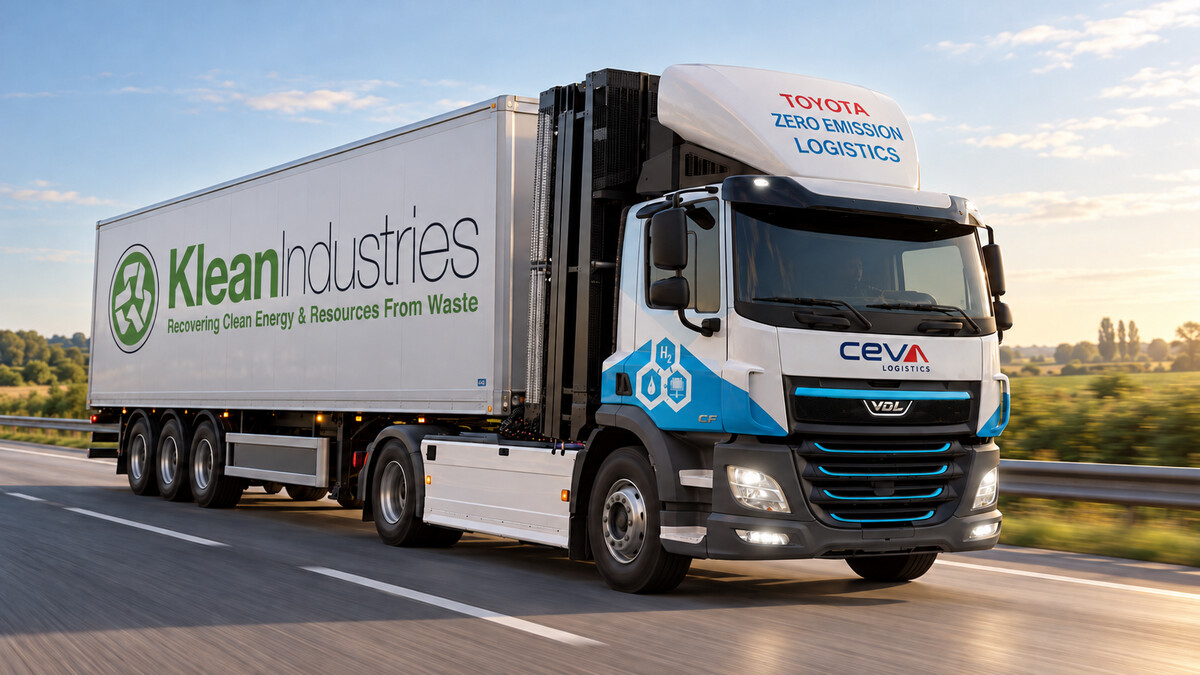
In the illustrative solar day, an 11.025 MWp array delivers 49.72 MWh after PV losses, assuming 70% roof coverage, 210 W/m² of panels, 5.5 peak-sun hours and an 82% performance ratio. The model allocates 12 hours to daytime operation and 12 hours to overnight operation. A Plug EX-2125D produces 320.4 kg overnight and 459.6 kg during daylight. With a 125 kW average building load, 90% electrical battery round-trip efficiency and 3 kWh/kg for compression and dispensing, the day requires approximately 48.7 MWh. The remaining 1.0 MWh is insufficient for a 21st full tank on that schedule.
A depot starting dispatch with 1,170 kg of usable hydrogen could dispense 780 kg and retain 390 kg, equivalent to ten full truck fills. The reserve requires an initial charge. Routine fuel-cell power, hydrogen losses or lower solar yield reduce the fuel available for dispatch. The 20-fill figure is a modeled day and requires an hourly site and station design check.
The DFS gave CMA CGM a basis for evaluating those decisions across its estate. For each candidate depot, the master plan links local solar yield and roof availability to building demand, fleet schedules, water and utility requirements, permitting and installed cost. A large roof above a quiet yard may have surplus electricity and few fuel customers. A busy depot with limited roof space may have the opposite problem. The most promising sites bring solar supply and recurring freight demand together. Other carriers could become customers where yard access and spare dispensing capacity allow.
The roof opportunity and the fleet demand are both visible in CEVA’s operations
In 2023, CEVA outlined a roughly $180 million rooftop solar program with its real estate partners. Its 2025 sustainability report recorded nearly 760,000 m² of photovoltaic panels across its worldwide facilities. This is a useful precedent for securing roof access and working with landlords across a portfolio. Our per-depot hydrogen estimate comes from our own feasibility work.
On the fleet side, CEVA announced a five-year hydrogen-truck trial with Toyota Motor Europe in 2023. The plan called for a dedicated freight route and refueling at existing stations along the way. In 2025, Toyota reported deploying four additional heavy-duty fuel cell trucks after its first demonstration vehicle, with CEVA among the participating logistics providers. Toyota reported a range of up to 400 km per refueling for the 40-tonne trucks.
For a warehouse operator, that route detail matters. A depot station can serve trucks where they already stop to exchange freight. Its value depends on whether the operator can place fuel in the right yard, in the right quantity, before the next departure. That was the commercial question behind our rooftop hydrogen study.
1. The depot already has potential customers for both products. The warehouse consumes electricity and the fleet consumes fuel. A predictable freight schedule gives the developer a basis for sizing both supplies.
2. Round-the-clock production and peak refueling are different duties. The heat sink and battery backup support the 24-hour electrolysis design. Hydrogen storage lets the station serve concentrated truck arrivals while preserving a reserve for warehouse power.
3. One master plan can guide many different installations. Applying the same feasibility method across the portfolio lets CMA CGM compare suitable roofs, fuel demand and delivered energy costs before choosing which depots to advance.
These are selected findings and lessons. Further engineering and commercial insights are available through an engagement with our team.
WHAT DO THESE LESSONS MEAN FOR YOUR PROJECT?
Start with a roof plan, an hourly electricity-use profile and the fleet’s return-to-depot schedule. Add vehicle fuel demand and the time each truck has available to refuel. With those inputs, we can scope an assessment of the generation, storage and dispensing capacity your operation would require.
For a new equipment project, a paid Detailed Equipment Quotation (DEQ) establishes the preliminary configuration and investment basis. A Detailed Feasibility Study (DFS) examines site performance and economics before Front-End Engineering Design (FEED).
Discuss Your Warehouse Power and Hydrogen Fleet Project with Klean >> GO.
ABOUT THE INFORMATION PRESENTED
We report the completed study and refueling potential at the scale evaluated. The Australian project was the proof-of-concept basis for the global master plan. CEVA’s rooftop solar figures and Toyota’s European fleet deployment are separate public operating references. We address detailed site engineering and operating assumptions through a project-specific engagement.
