
Continental Advances Tire-to-Tire Recycling With Recovered Carbon Black From End-of-Life Tires
Continental Advances Tire-to-Tire Circularity With Recovered Carbon Black From End-of-Life Tires
Recovered carbon black produced through end-of-life tire pyrolysis is moving further into mainstream tire manufacturing as Continental expands its use of circular raw materials.
Continental is demonstrating how recovered carbon black produced from end-of-life tires can move beyond recycling theory and become a functional raw material in commercial tire manufacturing.
At its tire manufacturing plant in Korbach, Germany, Continental is using recovered carbon black (rCB) supplied by Pyrum Innovations AG in the production of Super Elastic solid tires. The material is recovered from end-of-life tires through Pyrum’s pyrolysis process and reintroduced into new rubber compounds, reducing the requirement for fossil-derived virgin carbon black while helping Continental lower the carbon footprint associated with tire production.
This is important for far more than one tire product.
The commercial use of rCB by one of the world’s major tire manufacturers represents another significant step toward establishing tire-to-tire circularity as a practical industrial model—one in which end-of-life tires are increasingly viewed not simply as waste requiring disposal, but as a strategic source of carbon, hydrocarbons, steel and other materials capable of being recovered and returned to manufacturing.
For the rapidly developing recovered carbon black industry, Continental’s activities also reinforce one of the most important principles necessary for the continued commercialization of tire pyrolysis:
Recovered materials must ultimately find their way back into high-value industrial applications.
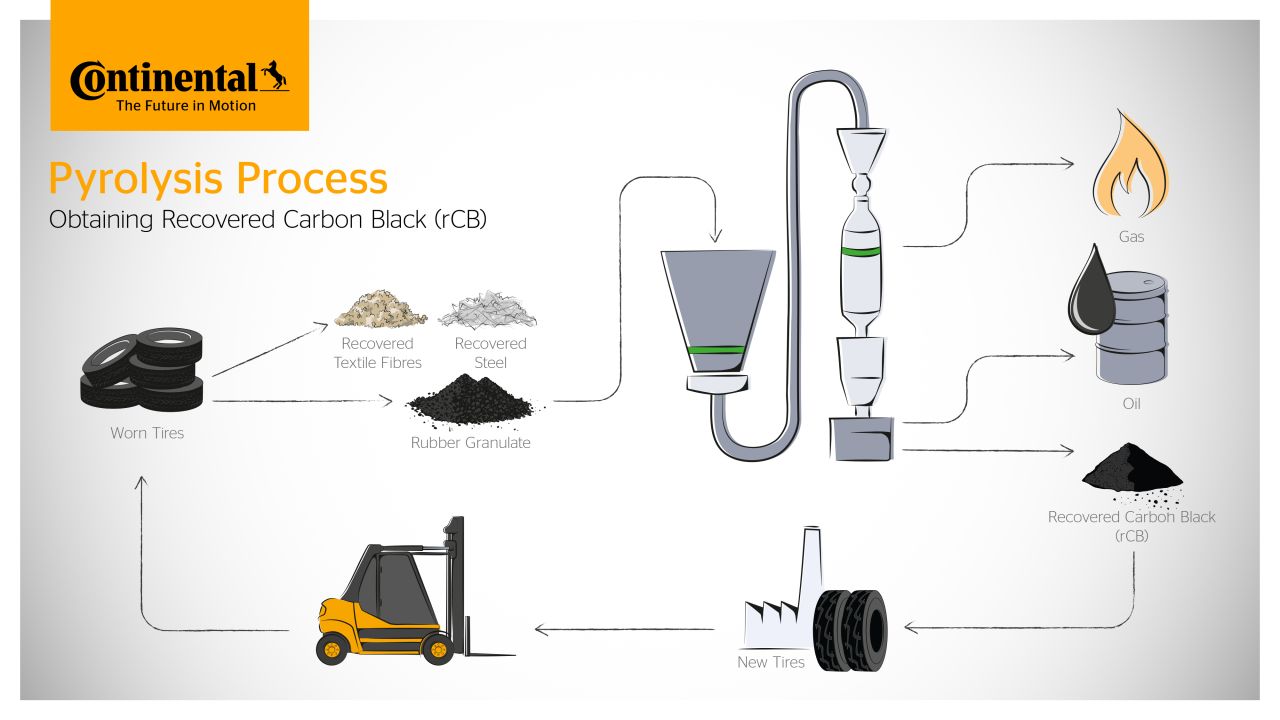
From End-of-Life Tire to New Tire Material
Traditional carbon black is predominantly manufactured using fossil hydrocarbon feedstocks. It remains an essential reinforcing material in tire and rubber production, contributing to properties including strength, abrasion resistance, durability and overall performance.
End-of-life tire pyrolysis creates an opportunity to recover a substantial portion of the carbonaceous material already contained within a tire rather than losing that material through disposal or lower-value treatment.
During pyrolysis, shredded or prepared end-of-life tires are thermally decomposed in an oxygen-limited environment. The process can recover several valuable material streams, principally pyrolysis oil, recovered carbonaceous material, steel and process gas.
The recovered carbonaceous fraction can subsequently be processed and upgraded into recovered carbon black suitable for defined industrial applications.
Pyrum uses its tire pyrolysis technology to recover these materials from scrap tires, with Continental incorporating the resulting rCB into rubber compounds used at its Korbach manufacturing facility. Continental says the substitution reduces its consumption of fossil raw materials and contributes to lower CO₂ emissions.
This circular pathway can effectively transform:
End-of-Life Tire → Pyrolysis → Recovered Carbon Black → Rubber Compound → New Tire
That is a fundamentally different value proposition from simply disposing of a waste tire.
It represents material recovery.
Continental’s Super Elastic Tires Already Contain High Levels of Sustainable Materials
Continental initially introduced the Pyrum recovered carbon black into its Super Elastic solid-tire production in Korbach.
Solid industrial tires operate under demanding conditions and are widely used on forklifts, airport vehicles, heavy transport equipment, sideloaders, platform trucks and other material-handling vehicles. They require high load capacity, durability and resistance to punctures while maintaining acceptable rolling resistance and operating efficiency.
Continental’s SC20+ solid tire already contains approximately 60% renewable and recycled materials, largely because of its high natural-rubber content. The addition of recovered carbon black further increases the role circular materials can play within the product.
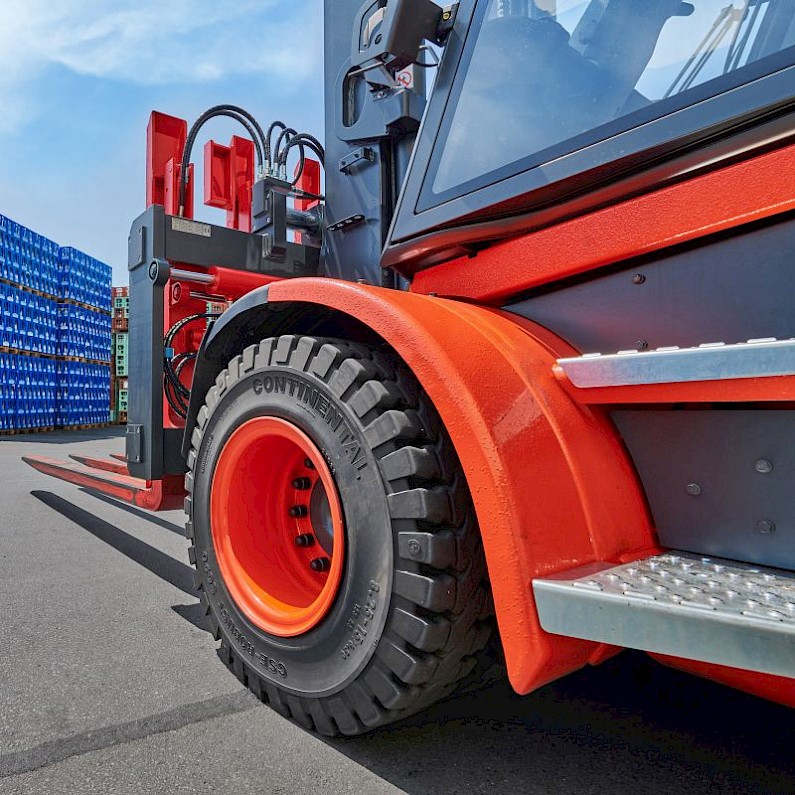
The significance is that sustainability is being integrated alongside—not instead of—the performance requirements expected from an industrial tire.
Matthias-Stephan Müller, Product Manager for Material Handling Tires at Continental, has emphasized that sustainability is becoming increasingly important within the specialty-tire segment while customers continue to demand characteristics such as low rolling resistance, long operating life and efficient resource utilization.
That balance between performance, economics and sustainability will be essential if recovered materials are to penetrate tire manufacturing at meaningful scale.
Continental and Pyrum Move Beyond Development Into Long-Term Commercial Supply
The relationship between Continental and Pyrum has progressively expanded.
In March 2022, the companies announced a development agreement aimed at optimizing and expanding end-of-life tire recycling through pyrolysis, with the objective of producing high-quality recovered carbon black suitable for Continental’s tire manufacturing operations.
In March 2023, Pyrum announced a supply contract with Continental for recovered carbon black.
Commercial utilization followed.
Continental announced in September 2023 that recovered carbon black supplied by Pyrum was being incorporated into newly manufactured Super Elastic solid tires at Korbach.
The cooperation subsequently deepened further.
In July 2024, Continental announced a 10-year purchase agreement with Pyrum for recovered carbon black produced from end-of-life tires. Continental stated that it ultimately intends to use rCB in the series production of passenger-car tires as the companies continue development work aimed at further improving the material.
Pyrum said the framework agreement covers rCB purchase quantities associated with at least two Pyrum plants. The arrangement also includes Continental supplying end-of-life tires to Pyrum and providing an advance payment against future recovered carbon black deliveries.
That evolution—from research collaboration to qualification, commercial production and long-term offtake—is particularly important.
It illustrates the type of industrial ecosystem required to scale circular tire technologies.
Offtake Is Critical to Financing the Circular Tire Economy
Building industrial-scale tire pyrolysis infrastructure requires significant capital.
Technology alone is not enough.
Projects ultimately require reliable feedstock, technically qualified products, economically viable plants and credible customers prepared to purchase recovered materials under commercially bankable arrangements.
Long-term supply and offtake relationships can therefore become a critical part of project development.
The Continental-Pyrum relationship illustrates how collaboration between the tire manufacturer, recycler and recovered-material producer can help establish the commercial foundation necessary to expand recycling capacity.
The circular economy becomes considerably more powerful when the company producing the original product also participates in creating demand for the recovered raw materials produced after that product reaches the end of its useful life.
In effect, yesterday’s tire becomes tomorrow’s industrial feedstock.
Why Recovered Carbon Black Matters
Carbon black represents a major material component of most tires.
Consequently, recovering and upgrading the carbon contained in end-of-life tires offers the tire industry an opportunity to reduce dependence on virgin fossil resources while creating an additional destination for millions of tires reaching the end of their service lives every year.
The objective is not simply to create “black powder” from pyrolysis.
The commercial challenge is producing a consistent, characterized and application-qualified recovered carbon black capable of meeting the specifications required by downstream users.
Depending on the application and production process, this can require sophisticated post-processing including milling, classification, demineralization, purification, pelletization, quality control and compound qualification.
This distinction is crucial.
Raw tire pyrolysis char and commercially usable recovered carbon black should not automatically be treated as equivalent products.
Creating higher-value markets requires upgrading, standardization and qualification against the technical requirements of specific customers and applications.
Continental’s continued development work with Pyrum demonstrates how closely the recovery process and downstream material application can become connected.
Matthias Haufe, Head of Material Development and Industrialization at Continental Tires, has stated that the companies intend to continue developing end-of-life tire pyrolysis and expand the use of recovered carbon black into additional Continental rubber compounds.
Passenger-Car Tires Could Represent the Next Major Step
The progression into passenger-car tire compounds could significantly broaden the commercial relevance of recovered carbon black.
Continental confirmed in 2024 that it intends to use Pyrum’s rCB in series-produced passenger-car tires in the future and that the two companies are continuing development work toward that objective.
Passenger tires impose demanding requirements on rubber compounds, including abrasion resistance, mechanical strength, rolling resistance, wet performance, durability and consistency across high-volume manufacturing.
Increasing rCB utilization within these applications therefore requires considerably more than simply demonstrating that carbon can be recovered from an end-of-life tire.
The recovered material must become a reliable industrial raw material.
That transition—from waste-derived product to specification-controlled manufacturing feedstock—is one of the defining developments occurring across the recovered carbon black industry.
Tire Pyrolysis Is Becoming Part of the Raw-Materials Strategy
The significance of pyrolysis is also broader than recovered carbon black.
A properly configured end-of-life tire recycling system can potentially recover several valuable material streams from the same tire.
Recovered steel can return to metal markets.
Recovered carbon can be upgraded into rCB and potentially other advanced carbonaceous products.
Tire pyrolysis oil can provide a circular hydrocarbon feedstock capable of further processing and use in chemical, refining and carbon-black value chains.
Process gas can typically be utilized internally to help provide thermal energy to the recycling process.
Instead of treating the tire as one waste stream, advanced recycling separates it into multiple resources.
This creates the foundation for a substantially different tire lifecycle:
manufacture → use → collection → recycling → material recovery → upgrading → manufacturing
The closer these recovered outputs can return to their original industrial supply chains, the closer the tire industry moves toward true circularity.
Continental Targets 100% Sustainable Materials
Continental’s long-term materials strategy provides additional context for the importance of recovered carbon black.
The company has stated that it intends to use more than 40% renewable and recycled materials in its tires by 2030, and ultimately aims for new tires to be manufactured using 100% sustainable materials by 2050 at the latest.
Achieving targets of that magnitude will require multiple material pathways.
Continental has identified materials including recovered and sustainable carbon black, recycled steel and renewable raw materials as part of that transition.
Recovered carbon black therefore sits within a much larger restructuring of the tire industry’s raw-material supply chain.
The Bigger Picture: Creating a Circular Market for Carbon
The Continental-Pyrum collaboration demonstrates why the commercialization of recovered carbon black matters well beyond recycling statistics.
When a tire manufacturer qualifies and purchases carbon recovered from end-of-life tires, a new economic loop begins to form.
That loop can create demand for scrap-tire collection.
It can support investment in modern tire-recycling infrastructure.
It can create markets for recovered carbon.
It can reduce consumption of virgin fossil raw materials.
And, critically, it can provide the long-term offtake relationships necessary to support the financing and construction of additional recycling capacity.
That is where the circular economy moves from an environmental ambition into an industrial business model.
For decades, the global tire industry has faced the challenge of what to do with enormous quantities of tires once their useful lives end.
Increasingly, the question is changing.
Instead of asking how an end-of-life tire should be disposed of, industry is beginning to ask how much of that tire can economically become raw material for the next generation of products.
Recovered carbon black is likely to play an increasingly important role in answering that question.
Continental’s continued expansion of rCB utilization provides another tangible demonstration that carbon recovered from end-of-life tires can return to commercial rubber manufacturing—and that sophisticated pyrolysis, material upgrading, product qualification and long-term industrial offtake can combine to create a genuine circular value chain.
The tire of the future may therefore contain something extremely valuable from the tire of the past: its carbon.
Learn More:
- recovered carbon black technology
- how recovered carbon black is made tire pyrolysis technology
- advanced tire pyrolysis technology
- ecovered carbon black testing and ASTM standards
- recovered carbon black upgrading
- closed-loop end-of-life tire recycling
- tire pyrolysis and recovered carbon black plant development
Turn End-of-Life Tires Into High-Value Recovered Carbon Black
The global tire industry is actively searching for scalable sources of recovered carbon black, tire pyrolysis oil and other low-carbon materials capable of returning to tire, rubber and carbon black manufacturing.
Klean Industries provides commercially proven technology, engineering and project-development solutions for converting end-of-life tires into recovered carbon black, recovered tire pyrolysis oil, recovered steel and other sustainable commodities.
For project developers, tire recyclers, investors and industrial companies evaluating a new tire pyrolysis or recovered carbon black facility, Klean’s project-development process can assess feedstock, technology configuration, production capacity, product specifications, capital requirements, operating economics, potential offtake opportunities and project-financing pathways before major capital is committed.
Start with a Detailed Equipment Quotation and project qualification to determine whether your end-of-life tire recycling opportunity can be developed into a commercially viable circular manufacturing project.
You can return to the main Market News page, or press the Back button on your browser.
