
India Renewable Energy Investment, Battery Storage & Climate Finance Shape the Future Economy
India Renewable Energy Investment, Battery Storage & Climate Finance Shape the Future Economy
India’s clean-energy transition is moving from ambition to infrastructure.
New investment in solar power, battery energy storage, transmission networks, green hydrogen and climate technology is accelerating across the country. At the same time, water security, carbon markets, circular-economy infrastructure and access to capital are becoming increasingly important to determining which projects ultimately succeed.
The larger trend is clear: the next phase of the energy transition will not be driven by renewable generation alone.
It will require generation + storage + transmission + finance + resource efficiency + measurable environmental performance.
Renewable Energy Investment Moves Into Execution
One of the clearest examples is Maharashtra, where NOPL Solar Projects has secured a financing facility of approximately ₹2,941 crore from the Indian Renewable Energy Development Agency for a 969 MWac / 1,163 MWp solar project across 152 locations.
The project’s estimated cost is approximately ₹4,202 crore.
Large financing commitments of this kind demonstrate how renewable-energy development is progressing from capacity targets toward physical infrastructure backed by institutional capital.
Corporate renewable procurement is advancing alongside utility-scale development, with industrial companies increasingly using power purchase agreements to reduce energy costs, emissions exposure and dependence on conventional electricity.
Battery Storage Becomes Critical Infrastructure
As solar and wind capacity expands, energy storage is rapidly becoming one of the most important components of the electricity system.
Utex New Energy plans to establish a battery energy storage system assembly facility in Nagpur with an initial annual capacity of 5.5 GWh and a planned expansion to 20 GWh.
VSL PowerHive, a Vikram Solar group company, is separately developing a 7.5 GWh battery energy storage system assembly facility at Oragadam in Tamil Nadu, with plans for further expansion.
These investments reflect a fundamental shift.
Renewable generation produces electricity when environmental conditions allow. Battery storage enables that electricity to be stored, managed and dispatched when the grid requires it.
The value is therefore moving from simply producing renewable electricity toward controlling when and how that electricity reaches the market.
Transmission Must Keep Pace With Renewable Generation
Storage alone cannot solve the infrastructure challenge.
India must also expand the transmission networks required to move renewable electricity from high-generation regions to industrial centres and population centres.
POWERGRID’s acquisition of the Jam Khambhaliya Renewable Energy Zone transmission project in Gujarat illustrates the scale of infrastructure being developed around renewable-energy expansion.
The project is designed to support transmission associated with major renewable-energy zones and includes high-voltage transmission infrastructure and substations.
This highlights a critical principle of the energy transition:
Generating clean electricity is only valuable if the grid can transport, balance and deliver it reliably.
Green Hydrogen Needs Customers, Not Just Production Capacity
India’s ambitions are also expanding into green hydrogen, green ammonia and low-carbon fuels.
NTPC is engaging prospective buyers in Japan, South Korea and Germany as it develops international markets for green ammonia and other low-carbon fuels.
That commercial focus is important.
Large-scale green-hydrogen projects require more than electrolyser capacity and renewable electricity. They require dependable customers willing to enter long-term purchasing arrangements at prices capable of supporting project economics.
The same principle applies throughout the clean-energy economy:
Production capacity does not create bankability. Contracted demand does.
Climate Finance Is Moving Toward Infrastructure
Capital is also moving into the technologies required to manage increasingly complex electricity systems.
Investment in virtual power plants, energy-storage infrastructure, artificial intelligence and digital energy-management platforms reflects the growing importance of flexibility.
Virtual power plants aggregate distributed generation, battery systems and flexible electricity demand so that they can operate collectively as a grid resource.
As electricity systems become more decentralized, the ability to measure, coordinate and optimize thousands of distributed assets will become increasingly valuable.
Carbon Markets Add Another Economic Layer
India’s developing compliance carbon market could create additional incentives for industrial companies to reduce emissions and improve operating efficiency.
Carbon markets can help attach an economic value to verified emissions reductions.
But their credibility depends on accurate measurement, traceability, reporting and verification.
This is increasingly important across renewable energy, waste recovery and circular-economy infrastructure.
Environmental value must ultimately be measurable, auditable and defensible if it is going to support financing or generate long-term revenue.
Resource Recovery Becomes Part of the Energy Transition
The transition is not limited to renewable electricity.
Battery recycling, electronic-waste recovery, waste-to-energy, renewable fuels and circular-material production are increasingly becoming part of the same investment landscape.
As deployment of batteries, electronics and clean-energy infrastructure increases, so will the volume of materials eventually reaching end of life.
That creates both a waste-management challenge and a resource opportunity.
Metals, carbon materials, fuels, chemicals and energy embedded in waste streams can increasingly be recovered and returned to productive use.
The future economy therefore depends not only on producing cleaner energy, but on building industrial systems capable of continuously recovering and reusing resources.
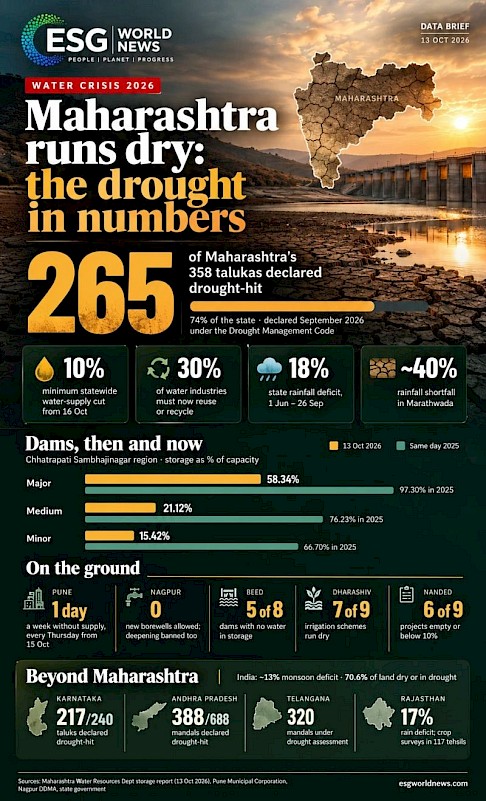
Water Security Is Becoming an Economic Risk
India’s energy and industrial expansion is also occurring against increasing pressure on water resources.
Water scarcity can affect agriculture, manufacturing, thermal power generation, urban infrastructure and industrial development.
For investors and project developers, water availability, wastewater recovery and process efficiency are therefore becoming important components of site selection and long-term project risk.
Climate resilience is moving from an environmental consideration toward a fundamental infrastructure requirement.
The Bigger Picture
Several themes are now converging across India’s clean-energy economy:
- Renewable generation requires storage.
- Storage requires stronger transmission networks.
- New technologies require financing.
- Large projects require contracted customers.
- Carbon markets require traceability and verification.
- Industrial growth requires water and resource efficiency.
And the circular economy requires infrastructure capable of recovering value from materials that would otherwise become waste.
The companies and projects most likely to succeed will therefore be those that combine technology with feedstock security, infrastructure, finance, offtake agreements, transparent data and measurable environmental performance.
Clean energy may begin with generation.
The future economy will be built around integrated, financeable and resilient systems.
Learn More:
- Project Financing & Funding for Sustainable Infrastructure
- Carbon Management, Emissions Reduction & Carbon Market Solutions
- KleanLoop: Digital Traceability for Waste, Resources, Energy & Carbon
Developing a Clean Energy, Resource Recovery or Circular Economy Project?
Klean Industries works with project developers, industrial companies and investors to structure waste-to-value and clean-energy projects around proven technology, secure feedstocks, marketable end products, project economics, financing and long-term commercial viability.
Successful infrastructure projects require more than technology. They require a clearly defined business case, reliable inputs, contracted markets, realistic economics and a structured pathway from project evaluation through feasibility, engineering, financing and implementation.
Start Your Project Evaluation » GO | Explore Project Financing & Funding » GO
You can return to the main Market News page, or press the Back button on your browser.
